|
This section has been added especially, as an additional benefit for the readers of Total Archery.
We have tried to explain each subject in the book as thoroughly as possible, however, there are always some areas which may raise further questions in the mind of the reader which would benefit by further elaboration.
There are now a total of some seventy two FAQs, covering just about every aspect of the KSL Shot Cycle and KSL techniques. Answers to all these questions are providing a valuable information base for both coaches and archers.
We receive many questions which have already been answered in previous FAQs. Before submitting any further questions please check the FAQs to ensure your question hasn't been answered already. Please note that due to time constraints, it might take a little while before your email question will be answered.
Q75- How to raise the bow
Q74- What is the Barrell of the Gun
Q73- What is NTS
Q72- Samick Sports reneges!
Q71- How can I have a tight anchor as well as a relaxed upper arm?
Q70- I have trouble getting good alignment due to shorter length long bones. What can I do?
Q69- KSL Gold Finger Tab- Aluminium or Brass?
Q68- What exactly is LAN2?
Q67- Do high level archers do a visual clicker check at the Loading/Transfer phase?
Q66- KSL Gold Tab - where to put thumb?
Q65 - Is it better to use a fingertab with a platform or not?
Q64 - My custom made grip slips when having sweaty hands. How to fix?
Q63 - Does Brady Ellison's release result in any torque?
Q62 - Please provide more detail about the 1000 Arrow Challenge
Q61 - How far should you turn your head towards the target?
Q60 - Should the bow arm scapula move towards the spine during Expansion?
Q59 - What do you recommend, high or low grip?
Q58 - Why use a high set-up and draw down?
Q57 - Should I shoot with one or two eyes open, which is best?
Q56 - String contact with face
Q55 - Difficulty with good timing
Q55 - StringPicture
Q54 - Bow hand flick or sit
Q53 - Wrist pain
Q52 - Checking clicker
Q51 - Drawing 2-3" below chin
Q50 - Keeping a performance journal
Q49 - 50/50 Release Synchronization Movement
Q48 - Bow arm movement on release
Q47- Target panic?
Q46- Focus during SPT-3(a)
Q46- Focus during SPT-4 (b)
Q45- Movement of scapula during expansion
Q44- What is the correct set-up position?
Q43- How do I check if I'm using the right muscles for back tension?
Q42- Should I pivot at the waist for longer distances?
Q41- Sight extension bar 9", 12" or 15"?
Q40- Do the KSL principles apply to compound as well as recurve?
Q39- How to avoid interference of string with women's breasts?
Q38- Is there a timing correlation between the various steps in the KSL Shot Cycle?
Q37- Bow hand and draw hand synchronisation on release
Q36- I have a corn on my index finger, should I keep shooting?(a)
Q36- What height should my elbow tip be in relation to the arrow?(b)
Q35- Warm-up exercises before ntournament?
Q34- What do you transfer during transfer stage?
Q33- Should I lean my shoulder in to come in-line?
Q32- How important is spine consistency in arrows?
Q31- When I draw the bow my chin goes up, how can I fix this?(a)
Q31- What size bow should I have with my draw length of 29"?(b)
Q30- Please explain what you mean by chest expansion?
Q29- Will excessive limb flutter affect the accuracy of the arrow?
Q28- How far do you go into the KSL Shot Cycle with Endurance SPT?(a)
Q28- Where can I get stretch bands for SPT exercises?
Q27- How do I get good string clearance without hitting my bow arm?
Q26- Should you focus on the sight or target when aiming?
Q25- When in the Shot Cycle should my shoulders be aligned with the target?
Q24- What bow poundage do young Korean archers use and at what age?
Q23- Can I change my style gradually to the KSL method?
Q22- Are the techniques employed in the book suitable for juniors?(a)
Q22- Can hydration be a substitute for solid food before a tournament?(b)
Q21- Where can I obtain the software for delayed video playback?
Q20- Where can I buy Total Archery in the USA?
Q19- How important is core strength for the B.E.S.T. method?
Q18- I would like to read about Mr. Lee's journey?
Q17- What type of shoe is best for archery?
Q16- Would it be possible to translate Total Archery into the Serbian language?
Q15- How can I avoid the string scraping my chin?
Q14- Why is it better to have the tip of elbow behihind the line of force?
Q13- Can you please provide information on camps and seminars
Q12- When should you do SPT exercises?(a)
Q12- Is there a preferred order of doing SPT exercises?(b)
Q12- Should I do SPT on both sides of the body?(c)
Q11- How do you align your shoulders and still keep your hips open to the target?
Q10- How do you evaluate the degree of string contact with the armguard?
Q09 - Why should the string hand not be parallel to the string?
Q08- What are the changes to the Second Edition?
Q07- What is meant be, "Reaching out towards the target"?
Q06- What is chest expansion and how do you achieve it?
Q05- How does the draw side scapula move on release?
Q04- How do you do you develop your back muscles to stabilse the draw scapula?
Q03- How do you develop your back muscles and know all is in the right place?
Q02- What should the draw thumb position be when drawing?
Q01- Shouldn't the draw be continuously?
top of page
| Question 75 |
Jan 2020 |
Kurt Eggerling |
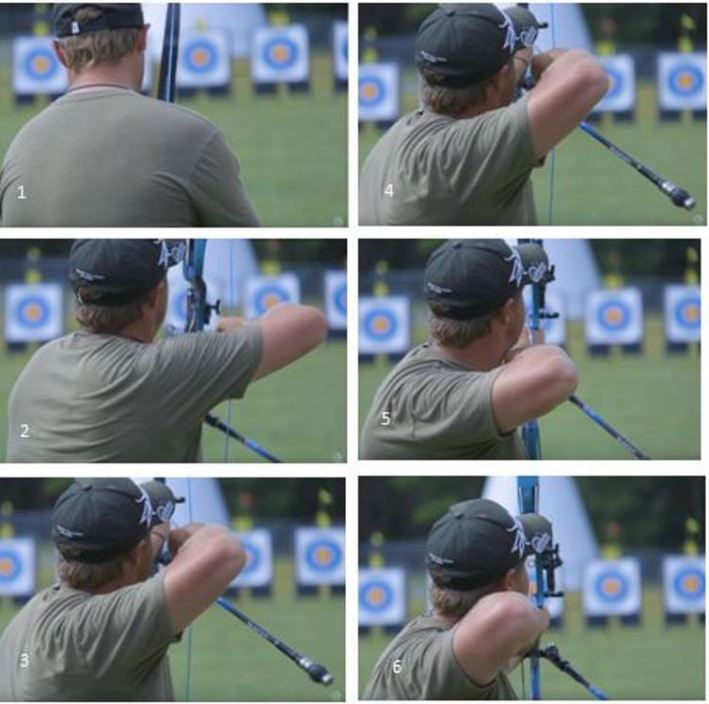
There has been some confusion and misunderstanding regarding this aspect of the shot. The main objective at the end of the Setup position is to achieve perfect bone alignment to achieve "The barrel of the gun";. | >
Below Coach Kisik Lee shares and illustrates his teachings on this important part of the shot.
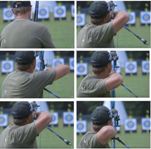 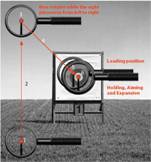
photos courtesy of Kurt Eggerling
Click photos to enlarge
RAISING THE BOW
“This applies to right handed archers; the positions are reversed for a left handed archer".
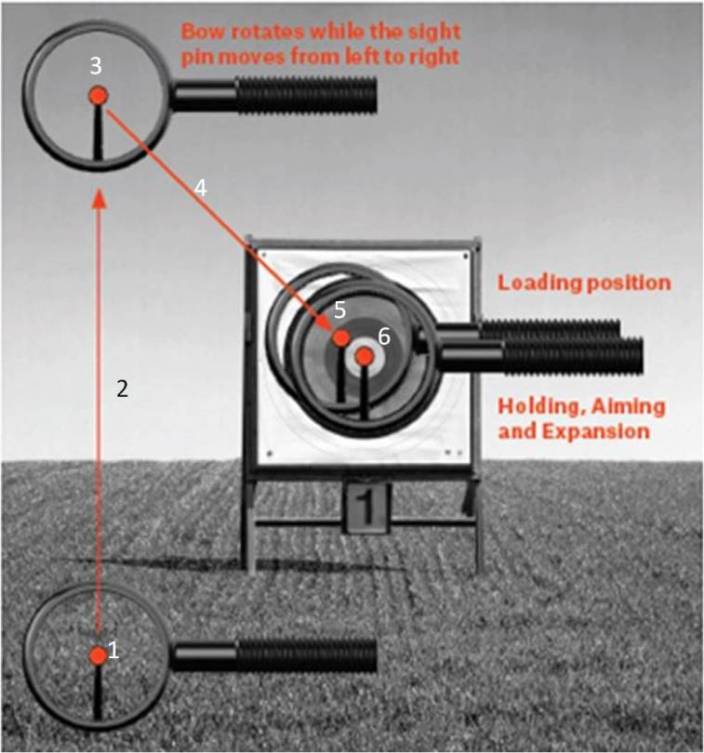
Setting the bow, including the hooking and gripping the bow, should be with the stabilizer pointing to the left, away from the target. This will allow the bow forearm to be more in line with the arrow line during the drawing process, promoting a stronger and more efficient biomechanical relationship.
Raising the sight should be in a vertical motion line to the left of the target and just to above the top of the target, with the stabilizer still pointing left, away from the target. Do not watch the sight pin whilst raising the bow, but focus on your aiming spot on the target. The main objective at the end of the Setup position is to achieve perfect bone alignment and achieving
"The barrel of the gun".
From the highest point, which should be about 11am in relation the Gold, the sight must now move from the 11am position in a straight line to the center of the Gold during the drawing phase to reach the Loading position”. |
top of page
| Question 74 |
May 2020 |
by Robert de Bondt |
|
Often we receive the question, "What exactly is the Barrel of the Gun" and when and how does one achieve this. This part of the KSL cycle forms part of all KSL's seminars and coaching sessions and is a vital component of the shot.
There are various videos on the Internet, but none explains it better as Jake Kaminski who trained for 6 years full time under Coach Lee at
the USA Olympic Training Centre at Chula Vista and a further 6 years during competions. Jake is a twice Olympic Silver Medallist (2012;2016) and has many World Championships medals to his name.
.jpg)
Please click "Barrell of the Gun" for video | >
top of page
| Question 73 |
May 22, 2012 |
by Roy Villasor |
What is the National Training Scheme - NTS?
Click Here for detailed explanation
| >
top of page
| Question 72 |
May 22, 2012 |
L.Z. - China |
Hi,
I wanna(sic) buy a KSL book to learn his techniques. I asked SAMICK BINGJING, they told me the English edition had 11 chapters, 203 pages and the Chinese edition had 11chapters, 117 pages. Could you please let me know where I can buy the Chinese translation.
Thank you.
|
Unfortunately Samick, without our permission as copyright holders, printed a Chinese edition. Any correspondence with them since, have been stone walled. Likewise a French edition was printed and also royalties were reneged on. The President of Samick Sport, Mr. Lee, bong-jay acted initially very honourable, but sadly no longer, for reasons only known to himself.
Sorry can’t help you with this one.
|
top of page
| Question 71 |
Feb 5 , 2012 |
H.S. - Germany |
Dear Mr. Lee,
I have studied your book intensively and rebuild my shooting style within the last year.
I have one question about the transfer and anchor which I do not quite understand.
You explain that in transfer one should take over as much power as possible by the muscles of the back, especially the trapezius region. The muscles of the drawingarm and hand should be as relaxed as possible.
On the other hand you say that one should have a firm anchor point in the face, that you should press the hand tightly into place.
In order to have a tight anchor one has to engage the biceps/brachialis muscle to stabilize the elbow joint. If the biceps is totally relaxed one cannot archieve a tight anchor. Without stabilising the elbow joint it is quite easy to push the hand laterally out of alignment. Therefore no firm anchor is possible.
Would you mind explain to me where I should place the priority? A tight anchor in the face or a relaxed overarm?
Thank you very much,
Kind Regards,
Dr. H.S., MD
Germany |
Dear Dr. H.S,
Coach Lee agrees with your concerns. We do need to have a solid/firm anchor, but not excessively so, otherwise our focus will shift away from our back muscles. As you said, we cannot totally relax the muscles, biceps, triceps and back of the hand as well, so we need to maintain some tension on those parts. However, the intensity of the archer's focus should be on the back muscles, not anywhere else. Please note that this is a concept and not something that has been, or can be scientifically measured. |
top of page
| Question 70 |
Nov 29 , 2011 |
A.A. - South Africa |
Dear Coach
I have been attempting to follow your techniques as written in your book Total archery. I have slightly shorter length long bones in my arms compared to my torso. This means I have trouble getting good alignment because it is biomechanically not possible. To achieve an anchor I have to either raise my elbow tip up (not recommended on page 56) , or bring my elbow tip “forward of the line” (as described on page 57) or I have to raise my head or lean it backwards. I would like to know which is the lesser of the evils?
Regards
A.A.
South Africa |
Be it as it may that you have slightly shorter length long bones in your arms, but the majority of archers do not have proper alignment, as is evident when you walk behind the shooting line of any competition and observe the archers.
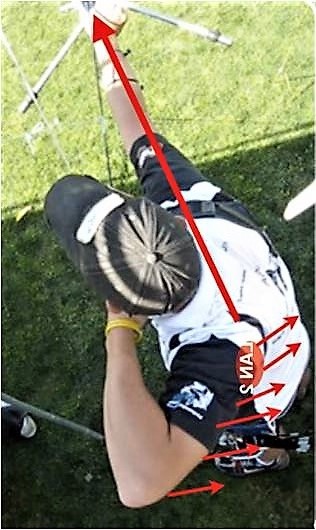
One of the major causes is that at set up, when archers move the elbow back whilst drawing before the shoulder is set back. It is very important that LAN2 is the first body part to move with the drawing motion, as otherwise it will be nearly impossible to get inline.see attached picture and set up description below. Refer also to FAQ 68 on our website for some further clarity on LAN2.
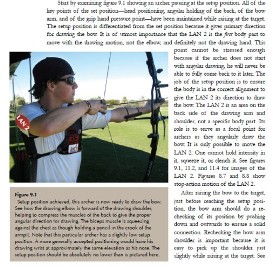
Raising your elbow tip will prevent you from engaging the lower trapezius and latissimus muscle, essential for the transfer phase and as such is definitely not recommended.
Leaning your head back is also not the answer, as that will introduce various other variables, detrimental to good form.
As I said before, for most people it is not easy to get properly inline, basically due to incorrect drawing technique and lack of flexibility. If you haven't got access to a coach familiar with the KSL technique, I would suggest you study the attached and FAQ 68 and then see a sports physio and explain to him/her what you are trying to achieve. They would then be able to give you the appropriate flexibility exercises.
Click here to enlarge picture
 Click here for German translation Click here for German translation
 click here for Thai translation click here for Thai translation
|
top of page
| Question 69 |
Oct 14, 2011 |
H.M. - South Africa |
Good day Coach,
Firstly thank you for 2 superb books - Total Archery and Inside the Archer. I am taking these books chapter by chapter and working gradually on improving my form.
Please can you tell me what the difference in performance of the brass KSL Gold Finger tab as opposed to the aluminium one is and which is the preferable choice?
Many thanks for your time.
Kind regards,
|
Thank you for your kind words re books.
Re finger tabs- Finger tabs are a very personal choice, a bit like a putter in golf; what feels good to one might not necessarily feel good to someone else. However, having said that, the thinking behind having either aluminium or brass is that brass is much heavier than the aluminium, which our archers feel gives them better momentum and control of the release, but as I said before, it all depends on personal feel.
We hope this will help you to decide.
|
top of page
| Question 68 |
Aug 10 , 2011 |
P.C.- France |
Hello Mr. Lee,
Page 60 of the French version of TA, you ask to concentrate on a spot LAN2 and move and push this spot towards the back..
My question is: which is the place or the anatomical zone of this spot (is it the shoulder) or can be described it.
Then, in which direction must it be this spot moved towards the back, is on-line with shoulders and the shooting plane of bow or towards the perpendicular back in the axis of the arrow.
Indeed, when I move closer the shoulder blade towards the spine my draw shoulder moves towards the back and this angular movement makes spread the hand towards the outside of the face at the time of the release instead of leaving on-line
towards the back in line.
Thank you very much of the attention which you will wear in my problem.
Very cordially,
P.G.- an old man of France
|
Below an explaination what LAN or LAN2 actually means –
“Basically Lan & Lan2 are terms used in martial arts sword fighting for ‘blocking’; ‘parry (turn blow aside) and basically obstructing/blocking an opponent’s movements. So basically it is a certain movement in martial arts sword fighting or using the cane or short staff in martial arts.
Coach Lee explains it as follows:- Let’s look at what a lot of archers do on release. Basically they do not rotate the drawing shoulder, but have a linear release. As such by not rotating the shoulder, they are blocking(LAN) rotational motion. Now by using the terminology LAN or LAN2 it will remind and focus the archer not to stop or impede the rotational motion. Therefore, if they do not move LAN2 they are ‘blocking/impeding’ rotational movement, necessary to execute the shot biomechanically correctly”.
LAN2 is not an anatomical part of the body, but an imaginary location near the shoulder, as indicated by the red area in the photo. It is a concept that the archer can use to visualize the movement of the draw shoulder. The direction of the LAN2 Spot is indicated by the small red arrows and is approximately parallel to the shooting line and slightly downwards.
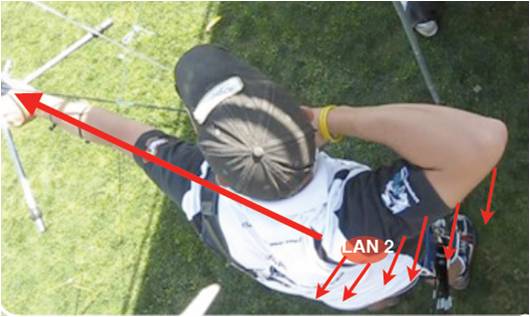
The reason that your draw hand comes away from your face is that there has to be a certain amount of tension in the drawing arm bicep to ensure that the included angle between the upper part of the lower arm and bicep doesn’t open up during the release. To focus on this place a pencil in the crook of the drawing arm and there should be sufficient pressure there to keep the pencil there throughout the shot.
|
top of page
| Question 67 |
June 11, 2011 |
A.E..- Egypt |
Dear Coach Lee,
In the KSL shot cycle you recommend a visual check of the clicker in the loading / anchoring stage. In the "Inside the Archer" book there is no mention of the clicker check and in the chapter of the Eye Focus its stated that eye focus start at the set position and continue on the target till the follow through. Is it not recommended for high level archers to do the clicker check?
Thank you,
|
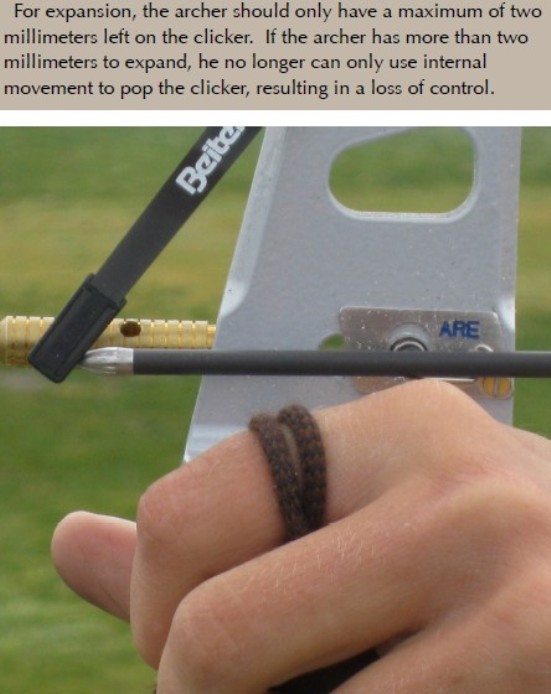
It is all a matter of control. If an archer can control the clicker at the loading phase, meaning that the clicker should be positioned as per photo, click here. For this reason, at the start of this phase, the clicker should be about 2mm from the end of the point. If the archer sets up further back than 2mm, then it is more difficult to control the force to make the clicker go off.
If an archer is struggling to get through the clicker, because the distance of expansion exceeds more than 2mm, the archer no longer can use internal movement to get through the clicker and will use other means, such as using more draw hand, pushing more with the bowhand etc.etc, all of which will result in loss of timing and loss of control of the shot..
Many archers do not have this clicker position consistency from shot to shot. As a coach you can observe these inconsistencies, when watching the position of the clicker on the point of the arrow for different shots. Therefore, for most archers, unless they can control the clicker, it is recommended to have a quick visual check of the clicker at the beginning of the Loading/Transfer phase. |
top of page
| Question 66 |
June 1, 2011 |
J.M.- South Africa |
Dear Mr. Lee,
I have just purchased a KSL Gold Tab and with reference to Question 65
I'm a bit confused, as where to put my thumb on the tab The instruction manual shows two pictures with the thumb on top of the shelf, whilst in the answer to Question 65 it states, " The shelf should not be used to rest the thumb on...."
Could you please clarify this apparent contradiction.
Many thanks.
|
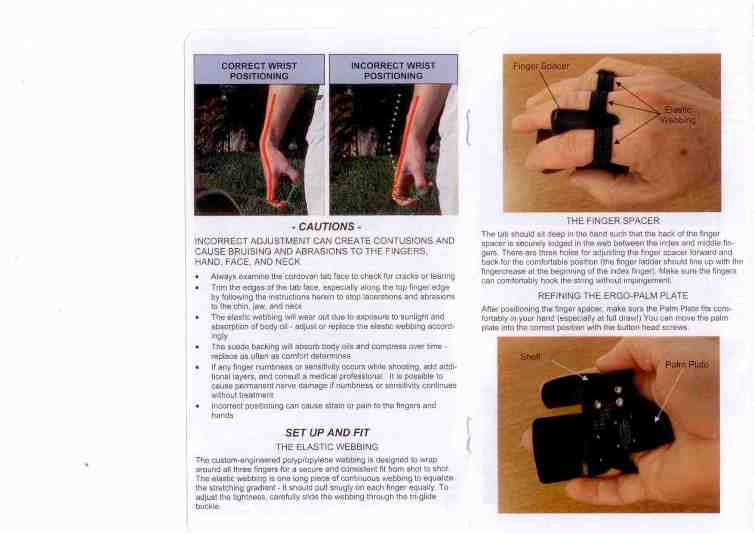
I agree with you that the pictures shown in the instruction brochure, see here, could give rise to confusion. Unfortunately, K.I.A. was not consulted to comment on this brochure prior to publication. However, be that as it may, it would appear that the prime purpose of these pictures are to show various parts of the tab and not how to hold the tab.Unfortunately, these pictures could give rise to confusion. The comments given in Q65 are correct. In addition, the thumb of the drawing hand should be positioned as shown in this photo. |
top of page
| Question 65 |
May 29 , 2011 |
A.C. - France |
Dear Mr. Lee,
I am particularly interesting in your training method. I am just a question about finger tabs. Is it better to use a finger tab with platform or not ?
I am looking forward to receiving a reply from you.
|
Shelf finger tabs have been around for a long time and to say is a shelf tab better or not is not really the issue. It depends entirely on how a shelf tab is used. The KSL Gold tab has a small shelf, which has been designed to be a secondary reference point only and the shelf itself should only make contact with the skin of the archer’s neck. The knuckle of the index finger should be the main contact point with the jawbone; as such the height of the shelf should be adjusted so that it is a few millimetres below the top of the index finger knuckle. The shelf should not be used to rest the thumb on or use it as the main contact point with the jawbone. If the shelf is used as the main contact point with the jawbone it would facilitate dissimilar tilts between different shots, or rock it on the jawbone, resulting in varying finger pressures on the string. |
top of page
| Question 64 |
April 7, 2011 |
K.S. - USA |
Hello,
I have a grip built with the specs you lay out in Inside the Archer (about 30 degrees from vertical and a 5 degree left-to-right slant). As a right handed archer at full draw, if my bow hand is slightly sweaty (a common occurrence) I find the bow will want to slide to the left so that the grip moves more towards the center of my palm.
I know in that section of the book you mention adding grip tape to the grip itself, but I wonder if in this situation adding tape would increase torque because the bow is trying to slide left. Is it OK to be adding grip tape in this situation? Or should I be looking at something form related to correct this?
Thanks for any help, |
Firstly make sure that the angle of the knuckles is at least 45 deg to the riser and preferably more. If it is less than 45deg the pressure point would most likely be more right on the grip and a sweaty hand could cause the hand to slide as you indicated.
I would suggest you could try some tape on the lower half of the grip, but keep it about 1” below the throat of the grip so when you slide the sweaty fleshy part of the hand into the throat it will position itself properly and then make full contact with the rest of the thumb muscle, ensuring that the pressure point is located on the outer half, left side of the grip, as described on page 43.
|
top of page
| Question 63 |
February 1, 2011 |
R.R. - USA |
Hi,
Your video of Brady Ellison appears to show a 'rotation' of the string wrist upon release, starting with the palm facing Brady, and ending with the palm facing towards the ground. Likewise, the bow wrist appears to rotate, starting with the palm facing the bow, and ending with the palm facing down. That is, the two hands rotate toward each other -- the bow hand clockwise, the string hand counterclockwise. Is there any torque during the shot that causes such a follow through? That is, is the rotation intentional?
Thanks, |
In answer to your question - " No this movement doesn't create torque. The wrist of the bowhand flexes down vertically on release which is intentional, but it is just vertical and no intentional clockwise movement is made. The draw hand just follows a natural path caused by the shoulder going further behind and is not intentional but a natural movement caused by the follow through”.
|
top of page
| Question 62 |
October 22 , 2010 |
W.L. - Germany |
Hello,
i´m an archer from Germany and saw on your website about the "1000-arrow-challenge".
Can you describe me a bit more detail how to do this.
Mit freundlichem Gruß - Best regards |
The following link and information attached should provide you with all the answers. Btw the distance they shoot at is about 5M. Click here for video link
Click here for further information |
top of page
| Question 61 |
October 12 , 2010 |
G.M - USA |
Coach Kisik Lee
Sorry to trouble you again but I would be grateful for some advice please. In recurve archery, how far should you turn your head towards the target? I noticed something on my last practice session that may be having an effect on groupings and just wanted to check. This is what I found:
I can turn my head quite far without any discomfort but sometimes noticed that the ledge on my tab was sitting nicely under my jaw whereas at other times I couldn't even locate the ledge because it was outside of my jaw or just connecting with the outside of the jawbone. I was wondering why I was getting these inconsistent anchor points until it dawned on me that it was all due to how far I turned my head. If I turn my head so it is virtually over my bow arm, I can clearly see the target with both eyes open but the muscle down my neck sticks out and I cannot anchor my tab correctly - it either floats outside of my jaw or just on the edge of the drawbone and the connection is not solid.
However, if I turn my head slightly, so that it faces 1 O'clock, both my eyes have to be turned left (I am right-handed) towards the target and my neck muscle remains relaxed such that my tab shelf fits nicely under my jaw.
Therefore, I was wondering if I should be turning my head 12 O'clock to directly face the target or 1 O'clock so that my eyes have to look to the left. I'm sure there is a simple answer but my dilemma is the compromise between a nice tab position under my jaw and the target picture. Obviously, if I turn my head 12 O'clock I get a nice complete target picture but a poor tab position. If I turn my head to 1 O'clock I get a nice tab position but a more strained target picture due to moving my eyes to the left. Which one (if any) is correct?
|
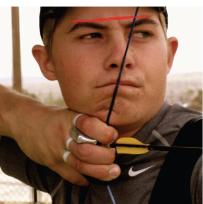 The eyes square to the target provides for a stronger neurological position. Obviously, if you try to do something new it doesn’t feel comfortable. However, if you can get your head to the 1 o’clock position I wouldn’t worry too much. One of the main things is not to change head position by even one mm from the Set position. Attached a photo of prefered head position. The eyes square to the target provides for a stronger neurological position. Obviously, if you try to do something new it doesn’t feel comfortable. However, if you can get your head to the 1 o’clock position I wouldn’t worry too much. One of the main things is not to change head position by even one mm from the Set position. Attached a photo of prefered head position.
|
top of page
| Question 60 |
May 14 , 2010 |
P.G. - France |
Hello mister Lee,
In the French version of TA, I noted that you speak about the concentration on the movement the one towards other one of the shoulder blades towards the spine what according to me means that the shoulder blade of bow also moves towards the spine.
However, you say that the shoulder blade of bow does not get closer to the spine but stays in low position.... Thus, it is fixed?
In front of these two opposite explanations I do not know any more what I have to understand to realize the good technique. Can let me know how I have to interpret these texts. Thank you for your understanding and for your answer.
Very cordially, P.G.
|
top of page
I think there has been a bit of confusion with the word Scapula in singular and plural terms. The singular term is Scapula and the plural can either be Scapulae or Scapulas.
However, in answer to your question, the bow arm scapula should not move once the archer has reached the “Hold” stage and also during the “Expansion” the bow Scapula should not move.
However, when you look at the photos on our website under Scapulae Photos you will notice that after the release the bow arm scapula has come closer to the spine, this however, is due to the angular release movement. If that were not the case it would be an indication of a push or pull release, rather than an angular release movement.
|
top of page
| Question 59 |
March 27, 2010 |
J.H. - USA |
Coach Kisik Lee
The Jager archery company makes a grip that is geared for shooting the BEST method. They have two different options, a high and low position. Would you recommend a high wrist position or a low wrist position? Thank you
|
The Jager grip is NOT an endorsed B.E.S.T. grip. Coach Lee has never given Jager any information to make such a grip. Coach Lee designs personal grips for his archers. Coach Lee had designed a grip for a very big guy and it is our understanding that Jager copied that grip. As such, most people can't use that size grip and many, many archers have had problems with that size grip. Grips should be personalized and tailored to suit each individual archer, which in some cases maybe a low, medium or high grip.
|
top of page
| Question 58 |
March 13, 2009 |
B.K. - Germany |
Dear Coach,
Nearly each archer in Korea starts his set-up position like shown in the shot sequence gallery on the website, where the draw hand is at the height of the nose.
Here in Germany we show the new archers that the draw hand must be about 10cm
lower and in one line with the chin, so that the new archer has do draw in one line - and the archer in Korea has to draw "from the top"
Why you prefer this way "from the top"?
Have a nice day !
|
The high draw, must be somewhere between eye and shoulder level. The
reason for this is to keep the drawing forces above the front shoulder
joint so that all the muscle action developed during drawing will be
directed downward. Especially when the bow draw weight increases the
forces must be directed downward, to keep the draw shoulder down,
without having to recruit any shoulder muscles to keep the shoulder
down. As the drawing shoulder has been set down already, prior to the
drawing, the downward forces compliment the shoulder muscles as they are all acting in the same direction.
Now if a low draw, as you suggest, is employed, the draw forces will
remain below the shoulder level, trying to force the bow shoulder up,
whilst the muscles of the shoulder are trying to keep the shoulder
down. As such you will get antagonism between two opposing muscle groups.
Have a look at the photo under SPT-4.
Now if you get archers to draw behind
their back like this they will get the feel of how the shoulders should
be positioned. Also they will feel the muscle groupswhich are involved. |
top of page
| Question 57 |
January 17, 2009 |
G.Z. - Hungary |
Dear Coach,
Thanks for your kind answer. I would like to wish you a Merry Christmas and a happy new year! and I would like to ask a question.
I would like to know if there is any difference between the one eye aiming and the two eye aiming. I mean what are the pros and cons of each of them, and what do you think is the better for a top archer?
thanks a lot!
|
The short answer to your question is to shoot with both eyes open. If one eye is closed it will weaken your concentration and strain your facial muscles. Further, both pupils contract and dilate together and if one eye is closed or covered with a dark patch, the pupil of the aiming eye will open wider, a reflex action, and admit more light. This creates glare in the retina and lessens visual depth.
Now, if people can't aim with both eyes open, which is usual the case if the dominant eye is on the opposite side of the dominant hand, called contra-lateral dominance, the dominant eye can be trained to stay open. However, it should be covered up with a translucent lens for about three month, if shooting with the dominant hand and aiming with the non-dominant eye. After about 3 months the brain should have been sufficiently trained to accept aiming with the non-dominant eye and both eyes can then be kept open. |
top of page
| Question 56 |
October 26 , 2008 |
K.O.E. - Germany |
Dear Coach Lee,
Firstly, thank you for sharing so much technical information on your website, which is a continuing well of information for many archers all over the world and is also followed closely by most of our coaches and club members. I have recently gone from recurve to compound and have used most of the form details described in the KSL Shot Cycle very successfully shooting compound. We recently had a lengthy discussion at our club in view of some recent articles published advocating no string contact with the face at all or at best, very light. Further, recurve archers are advised to centre the string on their chin and not having a side anchor, which seems to fly in the face of your teachings and the successes you have had with your archers. We would appreciate very much to hear your views on this.
Sincerely,
|
Rather than commenting on belief by others, I would like to share with you my teachings on the subject of string contact for both recurve and compound.
Firstly, the string is used for aiming for both recurve and compound and as such it is the rear sight for both. String alignment is extremely critical and compound has the advantage here, being able to employ a peep sight for perfect sight/string alignment. The string should not be in the center of the chin, but slightly biased to the drawing side, as it allows the archer to come more in-line. It should be noted that the face should be as much face on to the target as possible, for reasons I have demonstrated and proved many times at my lectures.A more face/eye on-position provides for a stronger bow arm and a better neurological connection to the back muscles. I have recommended head rotation exercises for some of my archers to be able to achieve a more ideal head position.
We must be careful to avoid too much side anchor, as high speed video analysis has shown flight inconsistencies of the arrow when going through the archer’s paradox. I advocate having the string touch the center of the nose lightly, as this provides the most repeatable reference point and in addition avoid any string clearance issues on release. The string must have a solid connection with the face, as it provides for a stronger neurological connection, making the bow one with the rest of the body and as such gives an overall stronger connection. This concept is not very well understood by most.
I sometimes use the analogy of two walls; if you can touch both walls with your hands you can push and develop more power. However, if the walls are too far apart than you can’t push the walls harder. Further, correct head and eye position is very important and the eyes must be level or slightly tilted towards the draw hand.
The above would equally apply to compound archers, with the only warning that for compound archers, draw length is critical. If the draw length is too long and especially with high let-off bows it would be easy to distort the string on the face and consequently there could be a considerable string drag on the face on release.
It is recognized, due to a constant string peep sight location that the vertical draw hand position for compound archers’ varies slightly on the face at different distances. However, recognizing this and assuming correct draw length is used together with a good head-on position, there is no good reason not to have a strong string face contact the same as for recurve archers, as the benefits will be for a stronger and more consistent shot.. |
top of page
| Question 55 |
July 23 , 2008 |
J.K. - UK |
Mr Lee,
Firstly, I want to say how interesting and helpful Total Archery has
been for me. I have used it as the main basis for rebuilding my form
after an injury and found it invaluable.
However, I have two problems, which I think are connected. If you have
time, I would very much appreciate your thoughts on them.
Firstly, in practice and with no target, I can produce very smooth
shots. With a target, sometimes I can shoot well but at other times I
find it very hard to shoot with good timing. I can set up on the point
of the clicker but it can take a lot of effort to pull through.
Although my alignment is good (compared with the pictures in your book
and on your website) and I clearly use my back muscles, I suspect I am
unable to relax my drawing arm muscles to let the back take over
completely. In competition especially my release is very bad, with the
drawing elbow dropping and the drawing hand coming away from the face.
No matter how I try to focus on relaxing my string arm I find at full
draw I am either gripping the string very tightly or have a very
shallow grip. Both result in a poor release, and my bow sounds very
loud because of this.
Secondly, I am very unhappy with my string picture. If I anchor with a
slight side anchor, the string is on the left of the sight ring (I am
right handed). It is hard for me to keep the string on the left edge
of the sight for consistency. If I anchor a little more around the
side, the string then aligns over the sight ring and it becomes
difficult to see the gold, especially at further distances. I was
never shown how to align the string when I started shooting so it is
very difficult for me to learn. Only when I shoot barebow with a high
side anchor point can I easily align the string on the riser.
When I am struggling with the string alignment I become even more
tense. It takes my focus away from the feel of the shot and the first
problem becomes worse.
I am not overbowed, shooting only 40lbs. I am doing reversal training
with heavier limbs (about 50lbs) using a formaster.
I very much want to shoot better, and would appreciate your advice on
what approach I should take to fix this problem.
I have a very good
coach, but he is very busy and I haven't had much chance to see him
lately. I want to be able to sit down with him and put together a
solid training plan to get me shooting to my full potential.
Thank you for your time.
Regards,
|
Many, many archers have your difficulty, but shoot well, smoothly and with good timing on a blank butt. However, once the target comes into play people focus too much on aiming. Have a good look again at the KSL Shot Cycle; aiming should ONLY start once 'Holding' has been achieved. Most archers never reach 'Holding' and pull through the clicker (as you said yourself too), rather than expanding through the clicker. By your own description you do not reach 'Holding' and as such you haven't transferred unwanted tension to your back muscles. How to fix this is another thing.
I would suggest, as part of your training routine, you start using a very light bow, like 18-20lbs and shoot very close up 5-10m. For you to be able to feel the shot, draw your bow and close your eyes and concentrate on each step, especially the Loading/Transfer phase, where you have to transfer the unwanted tension in your body to your back muscles. Visualize that your draw fingers are connected to your elbow by chains, which will help to be able to transfer the unwanted tension in your draw hand and draw forearm. You have to learn to expand through the clicker rather than pull through. Once you are able to do this with your eyes closed, now do it with your eyes open.
Once you succeed with that put a small target at 20M and try to do the exercise incorporating aiming. Once you are successful with that, try the same routine, closed eyes etc with your normal bow.
It should be noted that, besides other factors, your string picture is also affected by your bow grip. However, you should not have to fight your sight picture/string alignment as that will divert your focus.
Again, with your current set-up, draw the bow with your eyes closed till you feel properly aligned and anchored comfortably, then open your eyes and see what the string picture is like. Do this a few times and if consistent, keep that as your string picture. String picture is a natural result of your form and best to work on with a coach.
You indicated that you wish to shoot to your full potential and as such I urge you to see your coach to work on your challenges.
|
Top of page
| Question 54 |
April 18 , 2008 |
A.S. - Hawaii, USA |
|
Clarification on Question 49: Are muscles used to "flick"?
In your answer to question 49, you wrote, "To prevent any of these movements and ensure that the bow arm is kept still as long as possible, the bow hand must flick down from the wrist. This is a deliberate and quick movement and must be synchronized with the release, as such it is called “RSM50/50”. "
It sounds as if you're saying we should enlist muscles in our wrist to create a flicking motion, as opposed to just "letting" the hand achieve that position by maintaining complete relaxation in the bow hand/wrist throughout the release/follow through. Which way is correct? Use muscles to flick the hand down, or just "relax" and let the hand just achieve the "sit" position through complete relaxation? The book doesn't address the use of muscles to achieve the "sit" position. It just says the bow should be allowed to jump from the hand. Also if we are to enlist muscles to flick the hand down, would you say that it is a vigorous flick, or a light flick in terms of the amount of force exerted? Should I be "throwing" the bow away? How do I gage if I am using too much or too little force?
You also state that this motion is utilized to minimize bow arm movement. Upon release, the "snapping" of the scapulae causes my bow arm to drop about 10-15 degrees. Is this flicking designed to stop that? Should my bow arm be dropping?
Thank you very much for your help. |
As highlighted in the answer to question 49, we said in part:
”…. the importance is to maintain body balance throughout the shot. Similarly in the archery shot, balance must be maintained till the arrow hits the target. Now let’s go back now to the Holding phase, which initiates the aiming, expansion and release phases. We are now ready to release and the body is very well balanced, including the 50/50 front and back forces. However, when the string is released, refer Total Archery; pages 120 -123, a force imbalance between the front and back will occur. Unless certain actions take place the bow arm will either move left, right, up, down or even forward, which in effect shortens the barrel of the gun and of course the accuracy. To prevent any of these movements and ensure that the bow arm is kept still as long as possible, the bow hand must flick down from the wrist. This is a deliberate and quick movement and must be synchronized with the release; as such it is called “RSM50/50”. The purpose of this action is to counteract any tendency of movement of the bow arm and as such to keep the barrel of the gun long and more accurate”.
To answer your question - The flick or flip of the wrist must not be vigorous, as it is a coordinated movement with the release hand and would take about the same time as the time it takes the release hand to travel to the end of its movement during the release. This step also allows you to keep your bow arm still and prevent it dropping.
The pressure is on the thumb pad muscle of the bow hand as the draw force of the bow presses against it. We have to remember that the bow hand is not just static as the pressure on the bow hand changes from holding to release to maintain the 50/50 balance in the shot. The flip of the wrist will compensate for the imbalance on release and by flipping the wrist down the bow is assisted to travel in a straight line to the target; the bow is definitely not “thrown” towards the target, but “pushed towards the target by the wrist flip and the residual energy of the bow, as not all the energy goes into the arrow and some of it is transformed into a forward force as well.
I haven’t seen you shoot and there could be various reasons, however, the “snapping” of the scapulae on release could be the cause for your bow arm dropping 10 – 15 degrees. Coach Lee has found that snapping both scapulae can cause this problem and as such he would like to see that the bow arm scapula remains in same position from ‘Holding” to release. This will also ensure a constant length of bow arm to bow from Holding to release. This is also part of the concept of the ‘Barrel of the gun’. Further, if the triceps of the bow arm aren’t firm, then control of the shot will be lost. |
Top of page
| Question 53 |
March 31 , 2008 |
R.T. - USA |
I am 59 years old, and generally in excellent physical condition. I have recently (3 months ago) taken up recurve target archery and have very quickly become addicted. I absolutely love it. I have been pouring over your book, and also getting a few coaching lessons from an experienced teacher very familiar with the B.E.S.T. method. I shoot with some excellent recurve archers who have been helpful and supportive. I have begun to have some irritation and discomfort in my wrists, both of them, but mostly in thedraw arm. I am using 30 lb. limbs (just switched from lower quality 28 lb.)and the draw weight seems not a problem for me at all. So far I have been using moderation, a wrist wrap and the occasional Advil to keep things in check. Do you have any suggestions for what I might do to address this situation-to improve it or at least keep it in check so that it doesn¹t get worse? I know form makes a big difference, and my improving form has helped somewhat (page 52 & 53). I wonder if others have a similar problem? I look forward to your insight into myProblem.
Thank you,
|
Without seeing you draw the bow it is a bit difficult to determine the cause, however, a common problem is that people draw straight to their chin and their wrist is then kinked putting a lot of strain on the wrist joints.The back of the drawing hand should be flush with the drawing forearm or even slightly convex when drawing the bow. To get a good idea of what the drawing hand and wrist should look like when drawing the string, pick up a rather heavy briefcase or anything heavy with your three drawing fingers and let the weight hang loosely without trying to lift it. Now have a good look at the position your wrist is in, which will show you the most natural and strongest biomechanical position of the wrist when drawing. |
Top of page
| Question 52 |
January 25, 2008 |
M.M - Switzerland |
| Dear Coach Lee:
When I check my clicker during the transfer-to-holding phase I notice that my draw gets to a still-stand or even a slight let-go (2-4mm), especially when drawing decisively as recommended in the B.E.S.T.
method. Is this OK or does it indicate some flaw in my technique? Do I need to slow down at the end of my draw at the end to avoid this let-go?
Thank you for your advice.
|
It is very difficult for me to answer this question without seeing you doing it, as there cpuld ne various reasons. However, let me explain the process as follows:
There is a rhythm of Loading, Anchor and Transfer, 1_2_____3. One being Loading, where the drawing scapula is set down and “locked” into position, whilst the drawing hand comes to anchor(2) on the face - the draw scapula must NOT move. You can see on the KSL Shot Cycle Diagram (on this website) that there is an overlap between the Drawing and Loading/Transfer(3) phases and that is where we change direction from a linear to and angular movement, so there is no STOP, just a change of direction. This overlap is designed to enable the smooth and continuous movement from linear to an angular movement.
You can liken it to a golf swing, the golf club is going to pause or looks like stopping on the top of the swing when changing direction from back swing to down swing. So that the clicker could stop or pause a short time or even could go forward a little bit.
This is good question, because the point of the arrow of some people's will actual stop and sometimes will even go forward a little bit, even though the archer is doing the right core steps. I would need to visually watch you shooting to establish accurately what is happening, but 4mm will be too much and might point to a loss of back tension when anchoring and going from a linear to angular movement. |
Top of page
| Question 51 |
January 8, 2008 |
B.K. - Germany |
Dear Coach Lee,
Page 52 in Total Archery – “The string must be drawn back in a straight line from the set-up to approx. 2 – 3 inches (5 – 7.5cm) below the anchor point and not directly to the chin”.
In Germany 99% of all archers are coming directly to their anchor point on their chin.
My question is, why do I have to bring the string 2 – 3 inches (5 – 7.5cm) below the chin and why can I not make a draw direct under the chin?
Thank you.
|
“It is very important to position the rear scapula correctly to be able to maximize the use of the stronger lower Trapezius. The reason why people want to draw directly to their chin is because they think of the shot as only a straight ‘push and pull’ action. You must understand that drawing and expansion is not in the same direction. Drawing is linear and expansion is angular (refer to the section “Technique – Angular Movement” for a more detailed explanation). Coach Lee therefore likes to emphasise this difference and break it into separate steps.
Thus, drawing down and then to anchor is a linear movement and from this point this linear movement must be transformed into an angular movement during the loading/transfer stage and continue throughout the expansion stage. Also drawing down below the chin will assist in correctly positioning the draw scapula”.
|
Top of page
| Question 50 |
November 30 , 2007 |
Coach - Australia |
I would like to share with you an answer I received from one of my archers who lives some 600 miles away from me and who I coach by video link, photos, telephone and monthly visits. I'm quite fanatic and insistent that my archers keep a Performance Journal and when I, again, asked, "You are keeping your Performance Journal up to date, aren't you?" I received the following answer, which delighted and demonstrated to me the great mental attitude that my archer had developed through keeping a journal.
|
| Well you will be pleased to know, yes I do keep my journal, a few actually... just in case I forget to write in my big one, I put notes in my work diary and my personal diary has little notes written all over it.. how I felt , what procedure worked best (what I was thinking about ) how I made the weather my friend.. cos I found that the things I could not change I had to change the way I reacted to them... and that worked.. eg the harder the wind blew, the more I thought of how it was going to push all my arrows into the Gold... instead of wondering if they were going to hit the target or not... and Oh how that worked!
|
Top of page
| Question 49 |
October 11 , 2007 |
J.M. - Australia |
Dear Coach Lee,
Lately there has been a lot of talk about the "Sit Down" method you teach and there seems to be a lot of misunderstanding and misinformation of this movement in the release cycle. I have used it for the last couple of weeks now and after a settling in period it seems to give me more accuracy and consistency in my release. Could you please provide some further information as to the thinking behind this movement?
Thank you,
J.M.
|
I created the phrase “Sit Down” only for our young kids, the Junior Dream Team, just so they remember the exercise as to “order” their wrist to sit down as they would do to their dog.
Of course there will always be disbelievers, but I have taught this movement now very successfully for quite a number of years. The archer must learn to let the bow jump cleanly from the hand. I teach this wrist movement to make the bow jump straight to the target. As a teaching method the shot should be made without a finger sling and the Coach should catch the bow on release. This method is described and demonstrated in Total Archery; refer page 120, photos 62.
We must understand that every sport evolves and develops refinement over time. I will explain the “Sit Down” movement, but I prefer to call it the “50/50 Release Synchronization Movement” or “:RSM50/50” for short. For this I will need to use my analogy of “the barrel of the gun”; the longer a barrel of a gun, the more accurate it will be.
Through the Biomechanical Efficient Shooting Technique, the B.E.S.T. method, all the parts of all the steps in the shooting cycle are part of that barrel. Any deficiency in any of the steps will make the barrel shorter and as such less accurate. Assuming that all the steps up to Holding have been implemented correctly we have a nice long accurate barrel. Now, to be completely successful the long barrel has to be maintained throughout the release and follow through.
As in all other sports the follow through is crucial for the successful execution of the entire action. It is like a chain, if one link is missing the connection with the whole will be lost. In a way we can compare it to the cocking of the wrists in golf, as part of the back swing and uncocking to generate maximum clubhead speed through impact. However, in the follow through the hands need to be recocked otherwise it would be impossible to control body balance and accuracy in the shot.
This is obviously very much of a simplification of a golf shot, but the importance is to maintain body balance throughout the shot. Similarly in the archery shot, balance must be maintained till the arrow hits the target. Now let’s go back now to the Holding phase, which initiates the aiming, expansion and release phases. We are now ready to release and the body is very well balanced, including the 50/50 front and back forces. However, when the string is released, refer Total Archery; pages 120 -123, a force imbalance between the front and back will occur. Unless certain actions take place the bow arm will either move left, right, up, down or even forward, which in effect shortens the barrel of the gun and of course the accuracy. To prevent any of these movements and ensure that the bow arm is kept still as long as possible, the bow hand must flick down from the wrist. This is a deliberate and quick movement and must be synchronized with the release, as such it is called “RSM50/50”. The purpose of this action is to counteract any tendency of movement of the bowarm and as such to keep the barrel of the gun long and more accurate.
To do this successfully the knuckles of the bowhand will have to make an angle less than 45 degrees to the horizontal, generally advocated; probably more something like twenty degrees. On release when the bow jumps towards the target the bow must be allowed to jump forward unobstructed and rotate freely without touching the index finger of the bowhand.
Further, a lot of archers have too short a finger sling, which will impede this movement of the bow. To check correct length of finger sling the tip of the thumb should be just forward of the throat of the grip at the maximum amount the bow can jump before being stopped by the fingersling.
.
Further, as you can not open your fingers quick enough to let the string go, neither can the bow wrist down movement beat the string either, so the movement will not effect or interfere with the forward movement of the riser, but will assist in balancing the 50/50 division of forces on release and maintain a long barrel/accuracy.
In conclusion please watch the RSM50/50 of the world’s top archers, including all Korean archers. As long as you can understand the biomechanics of the RSM50/50, there is no question.
|
Top of page
| Question 48 |
September 30 , 2007 |
M.M. - USA |
I realize this may seem like a simple question, but I have a disagreement with some of the local coaches on this issue.
On release of the arrow my view is that the bow arm should not move to the left, but more in a forward motion toward the target while the release arm moves backward and in a small arc because of the movement of the shoulder blade.
Others say that the bow arm is also supposed to move in an arc on release pushing both shoulder blades together, creating a arc with the body with expansion of the chest in the process. I have watched people shoot using this principal an they always seem to have issues with the shafts going left.
My sense is that the bow arm is already being pushed back where it is supposed to be so that on release the only arcing movement should be in the release arm. In my view the bow arm should be pointed at the target center and pushing gently in that direction.
Could email me some information as to which view is correct.
Thanks Yours,
M.M.
|
There can be a variety of reasons why the arrow would go left. However, please read carefully Step 9 of the KSL Shot Cycle (partly produced below), as well "Angular Movement".
On release the bow must jump freely out of the hand in straight line towards the target. Note: before any movement of the bow arm to the left takes place the arrow should be well out of the bow. The slight movement of the bow arm to the left is caused through the Ratio of Movement when continued back tension is maintained throughout the follow through.The movement of the bow arm to the left must not be a contrived movement, but a result of using the correct technique. If it is a contrived/deliberate movement, yes then the arrow could go to the left.
"If the follow-through is natural, the drawing hand, which should be very relaxed, will move backwards and stay in touch with the face following the jaw line for as long as possible. The elbow should go laterally behind with a natural resulting downward movement. The drawing hand must not drop down to the shoulder as part of the follow through, as that will cause the elbow to drop too far down. Additionally, the bow should be visualized moving in a straight line towards the target, although the bow arm will, due to the rotational expansion, move slightly to the left (RH archer) after completion of the shot.
|
Top of page
| Question 47 |
August 29, 2007 |
P.K. - Germany |
| Dear Coach Lee,
First I want to say, that I am full of respect to your work.
Now to my question: I think my technique is ok at the moment, but when shooting on 70 metre target I have a big problem. When clicker going off I can't release the shot (I am afraid of the clicker). Instead of releasing the arrow I let down. Sometimes I force myself to release shot, but in most cases I lose back tension. The only possibility for me to shoot some prober shots is shooting on short distances without a face. What shall I do now? Please help me, I have no idea, how to resolve the problem.
Thank you
|
This sounds like a big confidence issue and is a kind of target panic. This can be common with archers who don't know/understand the KSL Shot Cycle and use continuous drawing, rather than committing to the Loading/Transfer phase coming to Holding, prior to the Aiming phase.
I don't know what score level you are at, but by the sounds of it your total focus seems to be on the clicker, whilst it should be on the back tension, Loading/Transfer and Holding, rather than on the aiming and the clicker. Please read carefully Step 8 Loading & Transfer to Holding and Step 9, Aiming & Expansion and in particular,
"The activation of the clicker is a phase in the shot that must be sensed or felt, not listened for. This may be a difficult concept to grasp. However, if the archer waits to hear the clicker go off to allow the release, conscious thought goes to the clicker and again the connection with the core muscles will be lost".
I would suggest you get close-up to the target, blank butt, about 10M. Follow the KSL Shot Cycle, especially "At the beginning of the Loading phase, which commences during the slight overlap towards the end of the Drawing phase, (just prior to anchoring) it is recommended to have a quick visual check of the clicker position on the arrow to achieve greater consistency". You must commit to come to the Holding phase every time, no matter what.
Try to focus on the process and forget about getting through the clicker, but focus on your back tension and Loading/Transfer to Holding and expansion and the clicker will go off automatically. Do this some 10 times, but don't release, just let down and start again. Once you are comfortable with the clicker going off because of your back tension and not you pulling with too much draw hand tension, then try very third time to release when the clicker goes off. If this is successful put a blank piece of paper about A4 on and incorporate aiming. When this work start moving back 5M at a time repeating the process. Once you are really comfortable use a large target face, but only shoot for form not score. Your main objective has to be focus on back tension and the clicker is really incidental and must NOT be the focus of the shot.
Good Luck
|
Top of page
| Question 46 |
August 21 2007 |
R.R. - USA |
I can just go through the motions of the exercises. Or, I can do them while focusing on particular aspects of the shot -- for example, what is happening on the bowside of my back when I am pushing to the target during the Flexibility exercise. Or, during the Structure exercise, what motions are my shoulders going through, and what affect does it have on rotating the scapula? My question for Mr. Lee -- he probably designed them with more than exercise in mind. What does he suggest we focus on when doing them?
Thanks,
|
Question 46A:
I can just go through the motions of the exercises. Or, I can do them
while focusing on particular aspects of the shot
-- for example, what is happening on the bowside of my back when I am pushing to the target
during the Flexibility exercise.
Advice on website:
This exercise is done with an arrow in the bow and for safety reasons close up in front of a target butt. Draw the bow in the normal manner and attain the normal Holding position, followed by a ten second continuous expansion at normal expansion speed. The objective is to draw 1 - 1.5cm (~3/8" - 5/8") past the clicker, without any change in posture. Do 5 sets of 6 repetitions and take a rest of 30secs between each repetition and 2 minutes rest between each set.
Additional advice:
Firstly, DO NOT push towards the target!, other than maintaining a 50/50 balance between front and back. During the expansion phase the draw elbow should ideally go behind line; the draw scapula goes down further and rotates in, towards the spine, opening up the chest in a circular movement. This is basically a micro movement, but due to the Ratio of Movement, this will be sufficient to come the last 1-2mm through the clicker.
However the flexibility exercise is designed to teach the archer to continue the expansion till well after the arrow has left the bow.
Question 46B:
Or, during the Structure exercise,
what motions are my shoulders going through, and what affect does it
have on rotating the scapula?
Advice on website:
In this exercise the string is pulled behind the neck, see photo. This exercise is more an exercise to give the archer the feeling for the position where both the shoulders should be. From time to time I use this exercise for this purpose, i.e. when an archer has problems attaining the correct shoulder positions. This SPT 4 is also good for warm up purposes, including before the start of competition.
Additional advice:
Therefore the focus must be on keeping the front shoulder as low as possible and setting the rear scapula as low as possible. This should give you the feeling where the scapulae should be at the start of the transfer phase.
|
top of page
| Question 45 |
July 24, 2007 |
N.C. - SRI LANKA |
Dear Mr. Lee,
Do the scapulae come down a bit during expansion?
Regards,
|
During the actual expansion the rear scapula will move almost in a horizontal
direction towards the spine, but also down a little bit as well (remember that the scapulae has already been set down at the set-up). Bear in mind that the expansion is basically a micro movement, which is happening internally and you won't see any external movement.
Also carefully read Angular Movement and Step 9 on the website for a better understanding.
|
top of page
| Question 44 |
June 16, 2007 |
J.H. - USA |
Dear Coach Lee,
I’ve been working on the BEST method using Total Archery and then with one of the high performance coaches for around 6 months.
My questions are with regard to the pre-draw and setup positions.
I draw a 48lbs recurve bow at 31” draw length.
From the mindset I align my shoulders with the target while pre-drawing. When I come to setup position, my draw hand wrist is around 6 inches in front of my face and around 2 inches above my chin/anchor.
What do you think is a good pre-draw compared to an archers draw length?
Is there a benefit of having a higher setup position if so what do you think is a good point of reference?
Thank you
|
1. The distance from your face depends entirely on setting the draw shoulder and scapula and is dictated by the physical characteristics of each individual archer. Refer to our website, KSL Shot Cycle, which in part states, “The set-up position, see photos below, is achieved not by physically drawing the string back by using the hand and forearm, but by positioning the draw shoulder and scapulae. The photos clearly show what we are trying to achieve. It can be helpful when doing the set-up to visualize the string fingers being connected to the elbow via chains, which will allow for more relaxed drawing fingers, hand and forearm”.
Also refer to “Shot Sequence Gallery” and Photo 26, page 50 in TA.
Further, as explained on pages 88-90,TA, the ideal draw position really hasn’t got anything to do with draw length. In reality it is related to your shoulder position.
2. During the set-up both shoulders must remain as low as possible and the sight is not to be set any higher than the top of the target at the highest point of the set-up. Therefore, I can’t see any benefit in a higher set-up than pictured in Total Archery and on our web site. Using a higher set-up both shoulders would need to be raised more and then have to be pulled down again, against an increasing bow load.; as such it is not recommended.
|
top of page
| Question 43 |
June 7, 2007 |
G.T. - Singapore |
Dear Coach,
I have got a question.
When we are holding the bow at full draw, it is extremely difficult to feel if we are using the right back muscles. Without using a bow is there a way or exercise where you can demonstrate using our back muscles?
Thank You
|
One way to check for back tension is to bend your left arm (bow arm, RH archer) on your back and find with your thumb the bottom side edge of your draw scapula. Now put your draw hand on your face, as though you were going to shoot an arrow. Now move your draw arm back, like in a follow through without worrying about back tension. You will find very little movement, if any, of the draw scapula. Now do it again, but this time try to push hard with the bottom side edge of the scapula against your thumb. You should be able to develop quite a bit of pressure there, which should be maintained, right throughout the follow through till you hear the arrow hit the target. The scapulae have to come towards the spine on release. With most archers the scapulae on release will relax and open up. Have a good look on the web site under Technique/Scapulae photos, where David Barnes gives an excellent example, as to what should happen.. |
top of page
| Question 42 |
June 2, 2007 |
S.R. - U.K. |
:"Total Archery" is a great interesting read and has been very beneficial to my archery, although I'm a just little confused now when shooting at longer distances.
As my sight is set much lower, I'm wondering when I should pivot the waist to place my sight on the target in the KSL shot cycle.
If I place my sight on the gold (slightly above) this will effect my T-shape and effect my draw length as my bow arm is now placed higher in relation to my draw arm
Many Thanks.
|
This is a question very often asked. Let’s look at it analytically. The sight angle between 30M and 90M is in the order of about 6 – 8 degrees, depending on the poundage shot. There will be a need to slightly pivot at the waist at the longer distances and a slight shift of the centre of gravity forward (slightly more weight on the front leg), as tilting at the waist would otherwise move the COG slightly backwards and affect the archer’s balance. However, any tilting of the upper body at the longer distances must be done with the Set-Up and not when drawing back or when at anchor.
|
top of page
| Question 41 |
26th May , 2007 |
M.S. - Poland |
My question is on length of sight extension bar – I shoot a 50lb target recurve bow with a sight extension of 15inches. However, over the last year my sight extension has broken some three times and replacements are getting a bit expensive, as the manufacturer won’t replace it free of cost. I am reluctant to change to a more conventional length of 9” or 12”, as I feel that the 15” sight extension gives me greater accuracy. Could I please have your views on this issue?
Thank you!!
|
I think there are two issues here- one is accuracy and the second reliability.
Conventional wisdom has it that a longer sight radius should provide for greater accuracy. However, obviously it will depend on how steady one can hold the aim and the distance involved. Firstly, the radius of rotation of a longer sight bar gives more movement on the target face than a shorter one. Secondly, the longer the sight bar the more sensitive to movement it becomes and the sight pin could be floating all over the target face – this in itself could cause over-aiming and loss of focus.
A good test is to see if an archer can hold the sight pin steady enough so that it just moves around in the Gold at the distance being shot. If that is achievable than the sight extension length is ok and if not, obviously it is too long. Please remember that there is nearly always wind and that longer sight bars are more sensitive to movement. Therefore, it depends on the aiming steadiness of each individual archer to establish an acceptable sight bar length/sight radius.
On the reliability issue I can not really comment, other than to say to discuss this issue with the manufacturer. Also with your poundage being in the higher range, as is your sight extension, it might be worth examining your bow set up as obviously there must be a lot of unwanted vibration causing your sight bars to break, assuming of course that the sight is from a reliable manufacturer.
|
top of page
| Question 40 |
12th April , 2007 |
C.W. - USA |
|
Could these principles be utilized for shooting fingers and a compound bow? I would think that most but maybe not all techniques would apply. I have ordered k Lees book from Lancaster Archery for our recurve instructors for our learn to shoot classes. I want to totally reform my shooting technique and I want to make sure I have the correct system to follow. Any info would be greatly appreciated. I have started with the band and I am already grasping the concept of the stance, breathing, mindset,draw, shoulder placement aiming, follow through etc. If you would not recommend this system could you recommend another one.
Thank you!!
|
All principles for shooting an arrow with a bow, apply equally, be it recurve or compound. It is one of the human activities where the biomechanical principles must the same. Especially the Loading/Anchor/Transfer steps to ensure the compound archer uses the proper ‘Back-contraction’ technique. This is very important, as with compound it can be easier to loose proper back tension, as the holding weight is of course much less. Particularly with the severe cams used nowadays coupled with high let-off, it could be easy to creep forward if the proper back tension is not used.
|
top of page
| Question 39 |
5th April , 2007 |
M.R. - Finland |
|
Dear Coach Lee,
As a male archer I've never had this particular problem myself and I didn't find any answer to it in the book either. The question is: what can female archers do to counter the problem of bowstring pushing against the bust while drawing? I've seen this numerous times and it seems to cause major problems such as incorrect drawing arm alignment and bow tilting. I also suspect it creates harmful pressure to the string in release. Sport bra and a tight chest guard seem to help a bit but could the problem be better solved by a change in the stance?
Best regards,
|
I'm glad to learn you never had that problem yourself :-). I have come across this particular trouble with some of the lady archers I have coached and basically it is a form/posture fault. Although proper fitting clothing and undergarments are helpful, the problem of the bow string pushing against the bust and causing string interference is mainly because of the archer leaning back, away from the target, and pulling too much with their draw hand to get through the clicker, rather than using their back muscles.
When taking up the Set-Up position there can be a natural tendency to lean back away from the target to counteract the weight of the bow, which will worsen as the weight increases during the draw. It is therefore advisable to lean slightly forward to the target in the set-up position to counteract this natural tendency.
In conclusion, good posture and correct KSL back tension technique should solve the problem.
|
top of page
| Question 38 |
26th March, 2007 |
R.R. - USA |
|
Dear Coach Lee:
The KSL Shot Cycle II clearly shows the sequence of steps and where there is overlap (for example, between drawing and load/transfer). My question -- is there a correlation between the size of the ovals or steps and the relative amount of time each requires? That is, can I conclude that loading/transfer takes about as long as drawing, that expansion takes longer than any other step, and that follow through is a major step, taking as much time as load/transfer or drawing?
Thanks,
|
There is not a direct correlation between the size of the ovals. However, drawing should be pretty quick, as slow drawing uses more energy. The timing of the loading/transfer should be, with an archer trained in the shot cycle, about ½ a second. However, most archers learning this aspect would need about 1 to 2 seconds to go from anchoring to holding.
|
top of page
| Question 37 |
14th March, 2007 |
V.K. - Serbia |
Dear Coach,
There is one thing that you could help us, if you have few moments. We saw all the elements of the KSL Shot Cycle, but there is one thing that puzzle us: During the High Performance Coaches Seminar (Colorado Springs) it was said (chapter 12) as follows
12. Release the arrow. Once the clicker falls, then the release is made. Just let the string go by relaxing the string hand. The string hand will slide off the string and then spring back into the hook made when the string hand was positioned on the string. At the same time as the release is being made, actively drop the bow hand as if telling a dog to sit. Keep the tension in the back throughout the release.
This bolded sentence is not quite clear to us, since we can see this maneuver from the video clips of Korean National Team training session, but it is not emphasized in Shot Cycle. Would you be so kind to explain me the effect of this maneuver with the bow hand ?
Best regards, |
Both the bow hand and string hand should be visualized to be “connected” and the grip release must be synchronised with the string side release. The bow/grip hand of most archers has too much tension and as such the “telling a dog to sit” is a good thing to visualize and actively execute. Not everything is emphasised in the shot cycle as sometimes it is easier to visually demonstrate, rather than trying to explain every item in extreme detail in the shot cycle, which possible could confuse rather than enhance”.
|
top of page
| Question 36 |
7th February, 2007 |
T.O. - Tel Aviv, Israel |
Hallo,
I have two more questions, if it is ok.
As you said, a harmful corn could develop": it developed on my index finger (of the drawing arm).What should I do? should I keep training with the pain?
My second question:
"The tip of the elbow, when viewed from the side, should either be in line with the arrow or just a touch higher".
The structure of my jaw doesn't allow me to do this, my elbow is high, to high.how can I get it down? After I anchor, I can't move it down.
Thank you very much for your help.
|
No, don’t keep training, as it will just get worse. See you doctor and follow his advice. You have to change the string position on your index finger, see Total Archery, page no. 47, for recommended position.
The corn developed because your string was in the joint of your index finger.
The tip of the elbow can be a bit higher than the arrow line that is ok, but if too high you can not engage your lower scapula. Make sure when you draw to set the draw shoulder down first, then pull down in angular way to under under your chin to ensure that your draw scapula is engaged, see KSL Shot Cycle Drawing Photo B. Both draw and bow shoulders must stay as low as possible.
|
top of page
| Question 35 |
6th February, 2007 |
A.S. - ENGLAND |
Dear Coach,
I am a club archer and appreciate that my level of archery is way below those you normally teach and like many archers I get to shoot once or twice a week yet I still put in some asonable scores (around 550 25M indoors and 1150 FITA)
I find that before a tournament I am able to do some warm up exercises and try to get myself in to the right frame of mind with some visionary exercises, but for most competitions in the UK we only get to shoot six sighters before scoring takes place yet despite the body warm up with a stretch band, I am finding that I sometimes need the first 6-18 arrows to get in to my proper shooting routine which translates in to quite a few lost points (and possibly my 1200 star).
Tournaments tend to start in the morning and family commitments mean I drive to the shoot the same day getting there about an hour before the start. Can you recommend some exercises I can do easily behind the shooting line to get me better prepared?
Best regards, |
Firstly, I would recommend that you do some warm up exercises for 5-10 minutes as per exercises shown in Total Archery. Then do some archery specific muscle stretches. Normally, a warm-up butt(s) should be provided at tournaments, but lacking that I would suggest you do some SPT exercises, using your bow (no arrow), but you might have to do these on the shooting line, if the organisers let you. |
top of page
| Question 34 |
5th February, 2007 |
R.R. - USA |
Hi,
Coach Lee introduces a 'transfer' stage where you transfer the load to your back.
Question is, where do you transfer it FROM? Perhaps there is tension in your forearm during the draw that is totally relaxed after hitting anchor? Maybe your forearm is NOT like a bicycle chain during DRAW, but SHOULD become like a bicycle chain AFTER reaching anchor? And it is the relaxing of the forearm that starts the transfer stage?
|
This is correct and all as described in strep 8 Transfer/Holding on the website. One thing though, do not create a static bow arm as there has to be a 50/50 load distribution, back and front. Also read carefully “Angular Movement”.
|
top of page
| Question 33 |
3rd February, 2007 |
D.H. -RAMSBOTTOM, UK |
Coach ,
I am interested in all your comments about keeping the bow shoulder low, but when viewing the archer on your home page demonstrating the shot sequence, it seems like he is leaning his bow shoulder inwards to get in line, has he got it wrong or should I attempt to do this.
|
The bow shoulder must be kept as low as possible and the bow arm scapula is brought inwards to get as close in-line as possible, without rolling the shoulder in/forwards. If an arrow is laid across the scapulae at full draw than the arrow should be pointing to the right hand side of the target, for RH archer.
|
top of page
| Question 32 |
January 26, 2007 |
R.W. - SUSSEX - U.K. |
Coach,
I appreciate that the bare shaft shooting selection process should weed out any rogue shafts, but how important do you consider spine matching to be in a competition set of arrows for recurve archers. Have any tests been carried out to measure spine consistency of the shafts selected using this process? Might you be able to put a figure on it, e.g. +/- 0.005", or some such other figure.
Many thanks.
|
The three important factors in arrows is spine, straightness and weight. Spine consistency would be one of the most important factors in a set of arrows. The manufacturers do not specify spine variation for a set of arrows, however, spine consistency of X-10s are very closely matched. I can not put a figure on it as I have never measured it. However, the results of shooting a set of bare shaft arrows at say 30M, about three times, would show up any rogue arrow very quickly. You can measure as much as you like, but the proof of the pudding is in the eating. |
top of page
| Question 31 |
January 19, 2007 |
T.O. - Tel Aviv, Israel |
Hello Mr. Lee,
I'll be glad if you will answer me couple of questions.
The first one:
I'm trying to shoot like the you recommend (KSL shooting cycle)
and my problem is that as I am starting to draw the bow my chin goes up and it is
very hard for me to keep it in it's place.
How should I fix it?
Second question -
currently I'm shooting with W&W limbs and someone said they are too short for me, is it true?
my draw is 29", and the power of the bow is 36 pounds.
The length of the bow is 66".
should I get new limbs? (the riser length is 25")
Thank you very much. |
1. Most likely what you are doing is that when setting up, your bow shoulder goes up and consequently your chin. Also you probably start to lean away from the target when lifting the bow to counter act the weight of the bow. When setting up make sure the bow shoulder stays down. You will needs a little bit 'push and pull' during the draw, so don't just draw against a static bow arm. Use more triceps to keep down your shoulder like when squeezing towel (50/50 balance). Also speed up rhythm, if you pull the string slower, you will be loosing control.
2. Probably a 68"+ bow would be more suitable for you to prevent finger pinch. You will need only longer limbs because the riser is 25", which is fine.
Good luck! |
top of page
| Question 30 |
January 11, 2007 |
C.T.V., MD - Spain |
Hello,
I am a Spanish medicine doctor interested in bow shooting.
With the help of other bow shooters, we are trying to translate your article of the angular movement into Spanish, but we have some difficulties with the anatomical concepts you write in the article.
I would like to know the scientific names of the following:
- chest bones
- chest joint
When you describe the movement of the scapula to the backbone you say that it is a micro movement(and it looks like it were smaller than the movement of the chest bone to the chest joint, I can't understand that.
|
Chest bones - Ribs
Chest Bone - Sternum
During the expansion, which commences once we have reached holding, the tension increases in the lower back muscles creating a micro movement of the scapulae. Even though there is only a micro movement of the scapulae, through the Ratio of Circular Movement this micro movement translates into larger movements through the chest opening up, then through the shoulders and the arms (biggest movement). The Ratio of Movement is the result of correct back tension.
|
top of page
| Question 29 |
December 27, 2006 |
R.L.B. - Netherlands |
To be able to get maximum speed for my arrows I have turned my 46# limbs in as hard as I can. Even though I'm shooting very well I am getting a lot of limb tip flutter. Will this affect the accuracy of the arrow?
Many Thanks.
|
Limb flutter is basically a factor of the torsional
strength of the limb. When you watch slow motion video you will note that the limb tip flutter happens after the arrow has left
the string. However, the bow's reaction won't be good and will affect the feeling of stability. This might affect a
stable follow through to a certain degree. My suggestion would be to back off your limb bolts by 1/2 a turn or if you are really worried about the speed I would suggest to go up 2lbs in limb weight, i.e. if the manufacturer. of your limbs produce 48# limbs. Just remember that the Korean women shoot about 42# on the fingers; as such speed isn't everything |
top of page
| Question 28 |
December 4, 2006 |
C.H. - USA |
A couple of questions on the Endurance SPT that weren't made totally
clear by your website:
1. Exactly how far through the shot cycle is one supposed to go? Do
you just come to anchor and hold, or do you fully expand and hold?
2. Where can I find rubber bands that can stretch to a full draw length?
|
1. Just stay strong at the holding position after transfer, but no expansion.
2. Most sports stores and physiotherapists would have either the strip or round exercise bands. They usually come on a big reel and you can get any length you wish and in different strength, denoted by different colors.
|
top of page
| Question 27 |
November 29, 2006 |
A.L. - USA |
Dear Coach Lee
I've had a great time reading and using the KSL shot cycle on the website and have put it to good use. I do however have a major problem, I don't seem to be able to get good clearance on the string as it hits the forearm hard and occasionally get caught under the guard (OUCH!). Must the bow arm and hand be in a straight line with the shoulders? Or would it be a good idea for me to tilt my bow arm forward to allow more clearance, if so by how much should I tilt? Please help me out, appreciate it.
Best regards
|
Without seeing you I can’t say precisely why, but there are common mistakes in people’s form that results in insufficient string clearance.
Some of the common mistakes are:
1. The elbow joint of the bow arm should be nearly vertical, which gives more string clearance and also is biomechanically stronger.
2. The front shoulder must stay as low as possible. If the front shoulder is high it will also come more forward and reduces string clearance.
3. The sternum should be low and tucked in. Many archers stick their chest out, which not only produces a hollow back which is bad, but also brings the front shoulder forward and again reducing string clearance.
4. Just make sure that throughout the draw that you keep your bow shoulder, and for that matter your draw shoulder, as low as possible. When expanding make sure the bow shoulder doesn’t come in. Have a good look at all the pictures on the website and he bow shoulder of the top archers.
5.
Make sure to have proper tension on the thumb pad on the grip (More thumb finger push towards to the target) so that bow will jump straight.
|
top of page
| Question 26 |
October 25, 2006 |
D.G. |
|
I've been trying to find out if, when aiming, you should focus on the target and blur the sight or vise-versa. Is there a best way or is it personal preference?
Thank you |
|
Below is a short extract from Total Archery page 79, which should be self explanatory.
Principle of Eye Control
Once more, let us look at the way some other sports do it.
Looking at baseball, the hitter will not just try to look at the ball, but will also try to focus on the stitching of the ball. They want to see the ball very clearly, which can be further enhanced by going to a narrow external focus, which will allow a better look at the ball.
Similarly with a tennis player, when he hits the ball he doesn't look where he wants to hit it, but he focuses totally on the ball to ensure proper timing and impact and will not take his eyes off the ball.
The same goes for a golfer hitting the ball. The golfer has made up his mind where he wants to hit it too and the distance required and then focuses totally on the ball itself, right throughout the follow through. If the eyes are taken off the ball too early, to see where the ball is going, most likely a miss- hit will occur.
Equally in archery, the final focus has to be the target; not the sight pin and not the arrow. The eyes have to stay focused on the target till the arrow hits. Many archers try to watch the arrow and that is why they lose control and also the reason why lots of people have trouble aiming off.
Keeping the eyes focused on the target till the arrow hits, we call "Eye Follow Through". |
top of page
| Question 25 |
October 17, 2006 |
D.L. - South Africa |
|
Many thanks for the wonderful website and book!
My question regards the set-up. Should an archer turn shoulders into line before or after raising the bow. My current procedure is as follows. I raise the bow, turn the bow shoulder into line at the same time pulling the draw scapula down into the set-up position. Then I start the draw.
I have tried to turn into line before raising the bow and have found that the set-up position does not feel consistent.
Thank you |
|
You should have the shoulders in-line as much as possible at the hooking and gripping stage, without trying to force them into line. As a matter of fact with the bow in the hooking and gripping position it would be near impossible to align both shoulders with the target without drawing the bow. Then, when raising the bow the rear shoulder is set back aligning both shoulders with the target. Please study the description and photos on the website carefully. Also study the Shot Sequence photos closely. |
top of page
| Question 24 |
September 1, 2006 |
J. - USA |
|
Dear KSL,
I agree with everything you have said in your reply, however is it true that training in Korea is different to anywhere else in the world? If a young person were on a training program in Korea at what ages and poundage would they be expected to cope with, also would the training program support these demands.
Thank you.
|
|
In Korea they start in about Year 4 (9-10 years old) and practice with a rubber band for about 3 months to develop proper form, before even drawing a real bow.
From Year 4 - 6 (9-12 year olds) maximum distances shot 20 -30M. Most can score perfect scores at 20M and 350 at 30M on an 80cm face. Bow weight varies, but about in the order of 25-35lbs.
From Year 7 - 12 (13-15 year olds) max distances shot 30-50M and score 350 on a small face at both distances. Again bow weights vary, but are in the order of about 30 -45lbs, depending on individuals.
Year 10 - (15-16 year old) full FITA distances They won't be shooting maximum bow weights yet, as they are still continuing to develop. |
top of page
| Question 23 |
August 24, 2006 |
E.H. - The Netherlands |
|
Since 2 weeks I am studying your wonderful and convincing view/book on archery. As I am a common-style archer the question arises of how to change to the KSL-style shooting technique. As in our club there are no coaches that studied your approach and still teach the common-style approach Ii find it difficult to get myself started in changing my style to the KSL-style. Is there a way to start changing my style in a gradual manner or would it be preferred to start all over again?
Kind regards. |
|
We have translated the KSL Shot Cycle in your native language, Dutch, so all coaches, irrespective if they speak English or not should be able to understand what I'm teaching. As a start I would suggest you read the Coaching Newsletter on the website, which basically lists most common errors in form for the majority of archers in the world. Also try to study and implement the diagrammatic KSL Shot Cycle Technique. You can start by trying to implement one step at a time. Obviously every step is important, but 'set-up' and 'holding' are very critical components in the shot and most archers have problems implementing these. As I said before try to implement and focus on one step at a time and of course best would be to work with a coach or another archer who understands or who wants to understand and learn/teach the KSL method. |
top of page
| Question 22 |
August 13, 2006 |
A.M. - England |
Dear Coach Lee,
I have a 12 year old daughter (of a good athletic build for her age) who represents her county on a regular basis shooting the recurve bow. As she is now starting to move up to the next level of her archery. For example, better quality limbs and arrows and increased coaching without making her become bored and turning her away from the sport.
I was wondering how you approach the subject of improving the strength and endurance of a young archer without building increased visible muscle mass that would not be acceptable to see on a young archer or child. Are the techniques employed in the book suitable for juniors? I would say not. Any improvement would I believe allow for a more constant and consistent draw and her 'anchor' to be maintained. Her coach has noticed that the draw may not be being carried out correctly at the moment, i.e. too much weight on her top finger and not spreading the load to the index and lower fingers. I believe we can iron this out from sections of your book and the photographs that go with it.
We also have the problem that she does not really like to eat or drink in the mornings. Which is awkward when it comes to an early start for a competition. Although she will readily drink 'Lucozade' type products and cereal bars. Could hydration in the morning be a substitute for solid food until she or other archers are ready to eat properly? For her it is probably nerves which is something we will have to overcome by mental training before she can reach her true potential.
If you are able to give me any advice for my daughter which I may also pass on to other club members both junior and senior I would be most grateful.
Are you doing any seminars or coaching sessions in the UK that we or other club members could attend as it would be most beneficial?
Many thanks for your time. |
I think there are three questions here :
-
Strength & Conditioning techniques in the book; are they suitable for Juniors?
Answer: At 12 years old she is in at a very developing stage, both physically and mentally. Physically he bones are still growing and excessive forces on her growth plates must be avoided. I would suggest that you consult a qualified Sports Physiotherapist and explain the physical action required for archery and the physical weight and draw weight of the equipment and the draw weight changes that will be required down the track. They should then be able to provide you with SAFE archery specific strengthening exercises for your daughter.
-
Could hydration be a substitute for solid food until she is ready to eat properly?
Answer: Would you put petrol in your tank before you go on a trip or put it in when you feel like it? Again she is at a very developing stage and I would suggest to obtain professional advice from a Sports Dietician. Explain the situation and take it from there.
-
Are you doing any seminars in the UK?
Answer: No seminars have been planned for the UK at this stage.
General comment: Please make sure that it is your daughter who is the one who really wants to do archery and at the level you are talking about. |
top of page
| Question 21 |
July 11, 2006 |
T.B. - USA |
Dear Coach Lee,
You mentioned in Total Archery the use of a 'variable delayed video box" in conjunction with a video camera and monitor for use in coaching and self analysis. I have not been able to locate a retailer here in the US that stocks such an item. Do you have an internet source that one of these units can be purchased?
Thanks,
|
The system described in Total Archery, as used at the Australian Institute of Sport, is pretty sophisticated and is in the order of about US$4,000 and is run with dongle controlled software. However, we have located an another excellent software delay program by by SIMI Reality Motion Systems, Germany. The program itself costs 199Euro, approx. US$260. it requires a DV camera, laptop and preferably a 10m FireWire cable so that the DV camera can be placed just about anywhere to capture the archer from any angle. The laptop can then be placed in front of the archer on a table or stool, so that he/she can receive instantaneous feedback. This is one of the best coaching tools to assist both the archer and coach.
System requirements
* PC (preferably a notebook) with Microsoft Windows 2000 or Windows XP and 256 MB RAM
* FireWire interface (IEEE-1394)
* Large hard disk to store video sequences
* Optional: CD writer
* DV camera with FireWire interface, cable
Refer to the following website for more details and ordering information http://www.simi.com/en/products/vidback/index.html
|
top of page
| Question 20 |
July 7, 2006 |
E.K. - USA |
Where can I buy a copy of Total Archery in the USA?
|
| Your best bet would be to buy it through the USA Archery Official Online Merchandise Store, see link below. |
top of page
| Question 19 |
June 21, 2006 |
D.M. - Canada |
What is the best way to approach the B.E.S.T system. I understand core strength is paramount to being able to support a lot of the movements? Should core strength be the first to achieve and then train after with the rest of the technique building? Or is there a way to build technique without having the most efficient core strength. Until you've built your core strength?
Best Regards,
|
Obviously core strength is a very important factor and detailed exercises are given in Total Archery, pages 143 & 144, to improve the power zone. These exercises are aimed at developing and strengthening the core of the body, “the power zone”. The strength radiating from the power zone can be likened to the ripples created when throwing a stone in a mirror smooth lake. The ripples will affect the entire surface of the lake and likewise the strength generated in the power zone will radiate to all parts of the body. Also remember that the power zone or trunk of the body connects the lower and upper half of the body, therefore, any weakness in this area will affect many aspects of the form including stability. Core strength is an integral part of the overall technique; however, it can be developed simultaneously with technique building. You should be able to develop a good core strength within 12 weeks through a properly developed training program.
|
top of page
| Question 18 |
June 16, 2006 |
A.V. - Australia |
Hi,
Could you put me on the email list for any coaching that Mr. Lee may do at the end of the year. Much appreciated.
Also, I am interested in Mr. Lee's testimony - his faith seems very real to him. I would like to read about his journey has he written it down?
Kindest regards,
|
You are on the mailing list:-). Mr. Lee will have only one seminar during his Christmas vacation in Australia at the end of this year, most likely of 2 days duration.
Yes, Mr. Lee's faith is very real to him, both in his daily life and in his approach to coaching. In the near future we will be publishing an interview on this specific aspect of his life.
|
top of page
| Question 17 |
June 16, 2006 |
D.M. - Italy |
Hello,
I am an archer from Italy and would like to know what the shoes are called on photo 64, page 126 of Total Archery.
Thanks
|
The shoes are called Adidas adiStar Shot Put Throwing Shoes.
They have a flat sole and thin hard inner sole and we feel that this shoe provides for a greater stability than the average joggers that archers generally wear, which have spongy inner soles.
Refer to http://www.everythingtrackandfield.com for more details. |
top of page
| Question 16 |
April 25, 2006 |
V.K. – Belgrade, Serbia |
Dear Mr.Lee,
I am coming from relatively small archery society, I am a member of AC «Kalemegdan» from Belgrade, Serbia. Archery society to which I belong is, as I said, relatively small, consisted about 100 archers, divided in 10 archery clubs, mostly recreate archers and just a few persons seriously involved in this sport, within the boundaries of their own capabilities. Unfortunately Serbia doesn't have certified coaches or other experts approved by FITA.
On the other hand by the summer of 2009. Belgrade is a host of UNIVERSIADE and we hope that the Archery shall be a part of the official program to this event. For that reason I strongly believe that in the near future Serbian archery will grow in large steps.
I am not going to say anything new when I state that yours «TOTAL ARCHERY» helped me, as well as many more archery worldwide, and that it is surely one of the most (or the most) useful books in this particular field, specially in situations where other professional help or assistance is not available.
For that reason I came to an idea to translate «Total Archery» from English to Serbian language, hoping that this should be one step in creating environment for significant progress of serious archery in Serbia.
Here I emphasize that this should be the first book about archery in Serbian (excluding Eugen Herrigel «Zen in der Kunst des Bogenschiessens» which doesn't have anything similar with the concept of your book).
Of course I am aware that there are certain legal aspects of this idea and some Copyright issues since I am a lawyer myself (specialized in Commercial law).
I hope that you will find some time to inform me about your opinion about this idea and if you are attending Croatian «Grand Prix», Porec 9-13.05. it will be my pleasure to meet you in person, and maybe discuss about the details.
With respect
|
We will need to refer your request to translate, Total Archery to Samick Sports who currently holds the publishing rights. Even though, we do hold the copyright, but any publication of Total Archery, in ANY language, will need the written approval of Samick Sports.
However, in the interim, you might consider to translate the KSL Shot Cycle, as published on our website, into Serbian. We do consider the KSL Shot Cycle to be a crucial component in coaching archery and we would like to publish it on our website in as many languages as possible. Just recently we have added the Italian translation.
Sincerely,
KSL International archery
|
top of page
| Question 15 |
April 6, 2006 |
B.E. - MN, USA |
Coach Lee - I have been studying your book religiously since purchasing it this past winter. Thanks for putting together such a great piece of work!
Here's my question. I have just begun shooting recurve archery after shooting a compound for approx 20 years. I think my form is technically strong. However, one issue that I continue to deal with is that I consistently scrape my chin with the string (receive a burn mark on my chin from the string).
Here are some specifics on my form: My stance is open as you suggest in Total Archery. My anchor is slightly off to the side of my chin. If I were to make it any less of a side anchor, I would be anchoring in the middle of my chin.
Are there any elements of my form that I can check to help eliminate this issue?
Thanks a lot for your help!
|
There could be a variety of reasons for this. However, there are a few main ones you should look at first.
The position of your side anchor sounds alright; however, if the string is pulled too hard into the chin, then on release it could scrape the skin. Also if there is too much tension in the draw fingers on release there will be more string deflection, which could scrape your chin. Check the attached picture and ensure that your head is straight and not tilted back or side ways, as this could also be a cause. |
top of page
| Question 14 |
March 10, 2006 |
S.N.- England |
|
Dear Coach Lee,
I hope that you are well and enjoying your move to the USA.
It was good to see you again and listen to your talk on B.E.S.T. I have been looking over the notes I made from your talk.
I hope that you do not mind me asking.
One of the points you made was that you wished to see the draw elbow, beyond the centre line of the arrow. This seems to break the line of force from the elbow to the fingers on the string. It was my understanding that the elbow joint should be directly behind the arrow - taking into account body proportions. This would seem to give more consistency if you use the analogy of the fingers are like hooks, attached by chains to the elbow.
Thank you for your time,
|
We have just added Step 9 - Aiming and Expansion to our website, which I would hope will answer your question more fully.
We must get away from the notion that expansion or the line of force as you call it, is just a linear movement and takes place only in a linear direction with the arrow. Once we can fully understand that this expansion is not just a linear movement of push and/or pull, but more a result of a big circular movement, which involves the scapulae to back bone (small movement); the chest bones connecting with the chest joint (bigger movement) and the draw and bow arms (biggest movement). This is the Ratio of Movement (Ratio of Circular Movement or ROCM)
This is why we advise that the drawing elbow/arm has to go "beyond line" as part of the circular movement. However, the draw fingers must remain in a straight line as much as possible. Because of the better biomechanical position of the scapulae it will be easier to execute a good shot and even on potentially "weaker" shots there is a mechanically built-in margin for error. On a properly executed shot both the draw and bow arm will move behind on release.
In addition please read Step 9 – Aiming and Expansion on this website under KSL Shot Cycle for additional information. |
top of page
| Question 13 |
February 22, 2006 |
K.F.V. - USA |
Could you please send me information on Coach Lee's camps and seminars.
|
Seminars are being planned for 5 regions, which are East, West, South, North and LA. Also there will be seminars at every USAT trial (Arizona Cup, Texas Shoot, Nationals etc......). A schedule of these seminars should be available soon from the NAA web site.
In addition annual coaching camps and seminars will be conducted in Australia over the Christmas/New Year period. Details will be available in the second half of this year.
|
top of page
| Question 12 |
February 21, 2006 |
F. S. de F. - Barbados |
Now to the point, the reason I am writing today is to have a few questions answered dealing with the SPT exercises.
1- Do you advise doing the SPT exercised before or after shooting. Such as SPT in the morning and target shooting in the evening?
2- Do you recommend doing the SPT exercises in the order A, then B, then C, then D. or can these be shifted. Also what repetitions do you recommend for C and D I have been unable to find any.
3- As an ex gymnast of 15 years I have some concerns with the effects of shooting and doing SPT exercises on one side of the body. I have for some time done as much as I can to balance my shooting. Such as - If I shot 10 Arrows I will shift the bow and pull it 10 times on the other side, it is not exact but it is an attempt to keep my body more balanced. Recently when I began doing the SPT exercises I have also made attempts to keep it balanced by repeating all exercises and hold times on the other side. However I have been advised that it may be best to stick with just my shooting side. One, that it may not be necessary as you have not advised it. Two, its just more work and fatigue that may not be beneficial to my shooting. How do you feel about this?
Thank you in advance for any insight you may give. |
SPT Exercises should be done at the end of the shooting day.
1. My archers usually do SPT for about one hour every day.
2. We usually do A, and then B, but order can be reversed. Exercise C can also be included and added after SPT A & B. Frequency of exercise C should be about 5 sets of 6 repetitions. Take a rest of 30secs between each repetition and 2 minutes rest between each set. If using all three SPT exercises in one session tailor it such that all three exercises take one hour in total.
SPT 'D' exercise is more an exercise to give the archer the feeling for the position where both the shoulders should be. From time to time I use this exercise for this purpose, i.e. when an archer has problems attaining the correct shoulder positions. This SPT is also good for warm up purposes, including before the start of competition.
3. I do understand your concern re exercise on one side of the body. However, with the sheer number of arrows that an elite archer will shoot in practice and in competition it would be impossible to balance both sides of the body equally. Other sports like tennis, javelin, shot put and the like have similar issues. In archery, with the drawing side more developed than the bow arm side we have to be careful that the draw side does not overpower the bow hand side. Therefore it is so important that the expansion comes from the back muscles, otherwise imbalance will occur and center of gravity will shift affecting the shot. I have no problem with strengthening the non-draw side with various exercises, other than SPT exercises, but I would recommend SPT exercises only for the normal shooting side, as also muscle memory etc. come into play.
|
top of page
| Question 11 |
February 16, 2006 |
G.T. - Singapore |
I have purchased the book and thank you for the information. Whilst browsing through the KSL web site I could find a FAQ section for this book. Incidentally, I would like to post a question over here.
The setup is the positioning the draw shoulder and scapulae to align them toward the target. How do the archer achieved this without twisting his waist ? At this stage , what is the relation between the waist and the upper body ? What do you meant by the "Hip Open to the target" ?
Please elaborate on the questions above.
|
When you use the open stance (refer photo no.20, page 46) your hips are on an angle to the target, which we call, “Hips open to the target”. Now, some archers when they align their shoulders with the target they also align their hips with the target, which is wrong. If the hips and shoulders are aligned with the target it is what is called a “Square stance”, irrespective of the feet position; the position of the hips determines the stance. You are able to rotate from the waste and leave your hips open to the target. To show this sit on a chair with your feet on the ground and rotate your upper body while keeping your feet in the same position. You will feel a little tension in the body just below the ribs. Refer to photo no.27 on page 50, which clarifies this further.
|
top of page
| Question 10 |
February 13, 2006 |
R.C. - USA |
As an archer improves overall alignment and form, including keeping the crease of the inside of the bow arm elbow close to vertical, should the coach use "buzz" (of the bowstring humming against the armguard as it vibrates at the end of the shot) on the armguard as a evaluation tool? In other words can slight string contact with the arm guard be considered either a positive thing or an unavoidable result of good alignment? |
I have never given much thought to his question, though archers who have excellent form and release should be able to shoot without it. Yet, there are probably only a few who don't wear an armguard, like one of my archers David Barnes. Most archers, including the world's top archers, shoot with an armguard. I suppose ideally there should be no need for an armguard as it would indicate a very, very clean release and very little string amplitude. However, all releases are not necessarily clean and therefore there would be quite often some string contact (buzz) with the armguard. If the archer has no armguard and they get stung a few times they might try to avoid string contact by trying to get their arm out of the way, affecting their form. If the string hits the armguard too much, then I suspect the archer has gone too far in trying to align or else has other flaws in form that, having been diagnosed, can then be addressed.Therefore better to shoot with armguard for the reason mentioned. (Edited 2/27/2006)
|
top of page
| Question 9 |
February 8, 2006 |
J.K. - Germany |
At our club there seems to be a difference of opinion amongst coaches as to the draw hand position on the face. Some of the older coaches say that the back of the draw hand should be vertical, parallel to the string, and others say that the top of the draw hand should make a solid and as much contact with the jaw as possible, which means a slightly angled back of the draw hand. Could we please have your views on this?
|
This is a common bone of contention with some coaches. Firstly, have a look at the Anchor/Holding/Release photos on this website which show some of the current top archers in the world and you will see that none of them have the back of their draw hand parallel to the string. Back in the 70's some top archers were shooting like this, however, like with any sport, techniques evolve and change. Techniques in running, high jump, pole-vault, tennis, shot-put and any other sport you might like to name evolve and change over time. This can be due to changes in equipment, high speed video analysis, biomechanical research into more efficient techniques etc.etc.; likewise in archery.
Trying to have the back of the draw hand parallel to the string, rather than keeping a natural, biomechanically strong hand position on the face in order to maintain strength through the hand, wrist and forearm, has some major problems such as,
1. It prevents good contact by the length of the hand and forefinger with the jaw when anchoring. When the index finger of the draw hand only makes contact with the jaw bone there is too much room for variation, which would result in varying pressures on the three draw fingers from shot to shot.
2. Because the hand and draw arm is forced, it will therefore result in an unnatural position and you will not be able to achieve a good alignment of the draw elbow.
3. Further, forcing the back of the hand vertically will result in a kinked rather than a straight wrist, which is biomechanically inefficient and can lead to wrist injury( see also answer to question 2)
The ability to get a good connection and transfer tension in the forearm and draw hand to back tension (which we all now know is the most biomechanically efficient way to ensure a good strong hold) is highly dependent on a natural process and alignment of bone and muscle. If you are twisting your hand to make it look vertical then this process will be inhibited.
4. The notion that the fingers come of the string at different times if the back of the hand is not vertical is a fallacy. If that would be the case then archer is trying to open their fingers rather than relaxing the draw hand and let the string do the work as shown in the photo below.
|
top of page
| Question 8 |
January 24, 2006 |
J.H. - USA |
I had looked at the Scapulae Positioning pictures on page 105 many times without fully seeing the movement that is so obviously presented through the use of lines, arrows and ovals on those same pictures in Form Photos of your web site. That Form Photos picture is truly worth a thousand words! Which brings me to my question: are those Scapulae pictures that utilize the lines, arrows and ovals available in TA 2nd edition? Are there other clarifications, improvements or corrections provided in 2nd edition? If so, would you please post them on this website for us 1st edition owners to see?
Thank you.
|
In the 2nd edition we have corrected some typographical errors, changed a couple of photos and changed the cover. However, in essence the second Edition of TA is the same as the first edition and no, the form photos shown on this web are not in the 2nd edition. We will endeavor to utilize our website to bring our readers any further technical developments, coaching and form issues and expand further on various items covered in the book.
|
top of page
| Question 7 |
January 24, 2006 |
R.v.G. - Netherlands |
Your answer to question 6, has made me now fully understand what is meant by expansion and how to achieve it. However, could you please clarify what you mean by, “Meanwhile, the bow arm continues to reach out towards the target, assisting the bow arm to stay down”. Refer TA page 60, third paragraph. If I reach out I have troubles bringing my drawing scapula in. Thank you. |
This probably could have been phrased better, however, what I mean here is for the archer to maintain firm triceps of the bow arm and direction towards the target. Quite often, some archers when trying to move their scapulae towards their spine, will as a consequence, allow their bow shoulder to come up. Therefore it is better to visualize as I said in answer 6.
“To give you this feeling of expansion, visualize a connection between the left and right hands. When the scapulae come more towards the spine a feeling of rounding and lengthening of the chest will be experienced and the distance between the two hands will be increased, if done correctly”.
|
top of page
| Question 6 |
January 23, 2006 |
T.H. - USA |
In your discussion regarding the question about the "Hold" section of the shooting cycle, you briefly mentioned "expansion of the chest". What is chest expansion and how is it done? I can increase the tension in my scapulae with no apparent movement of my chest or I can do it by also allowing my chest to slightly expand or move toward the bow/string. The latter is actually much easier so is this what you mean? I have also heard some folks describe it by saying one should relax the chest to get the clicker to drop. The latter doesn't seem to make any since because as I do that, the arrow moves further away from the clicker. (my shot collapses) What is chest expansion and how is it done? Thanks.
|
Firstly, have a read of item 19- Open Chest, page 121.Secondly, during the expansion phase both scapulae move towards the spine. This is basically a micro movement, but due to the Ratio of Movement this will be sufficient to come the last 1-2mm through the clicker. To give you this feeling of expansion, visualize a connection between the left and right hands. When the scapulae come more towards the spine a feeling of rounding and lengthening of the chest will be experienced and the distance between the two hand will be increased, if done correctly. As this movement is both ways, there is no apparent movement of the string when observed in relation to a mark placed on the chest guard. Please have a good look at the skeletal thumbnail picture below, which hopefully will explain it further.
|
top of page
| Question 5 |
January 18, 2006 |
T.L. - USA |
There is a lot of discussion about the draw side scapulae. What happens with the bow side scapulae? Does it lower straight down as the bow shoulder is pulled down, is it drawn in toward the spine, or is it held where ever it is after setup is completed? The various photos in the book and on the form photo page appears to not support moving it in toward the spine but I'm not sure. Please help!! Thanks.
|
| The bow shoulder is set down as low as possible at set up and on expansion is moved to the center of the spine, whilst the drawing side scapula is also set up as low as possible and on expansion will move down and to the center of the spine. Have a good look at photos numbers 30, page 54 and photo number 31 on page 55, which clearly show the movement of the scapulae. Photos number 55, page 105 show that both scapulae come in towards the spine on release.
|
top of page
| Question 4 |
January 17, 2006 |
P.H. -England |
Bow Arm -For the first few years as an archer I accepted the advice that shooting is the best way to develop archery muscles. However, last October I visited an archery shop at which a member of the UK squad works and he advised me to use a rubber band to develop bow arm posture (the vertical elbow crease). Previously I had thought that this was largely a knack as my arm would always rotate away from the vertical as I drew. He also adapted my built up (epoxy wood filter is excellent for this) Hoyt grip to look more like the Hoyt Ergo grip with the result that it is now easier to maintain the correct bow hand/arm posture.
Having read many leading books in the hope of mastering this skill, it seems the solution is to gradually build up the back muscles that stabilize the bow arm scapula using a rubber band to begin with (as mentioned on page 131 of TA) and to practice drawing and holding the bow (10 reps of up to 1 minute as endurance improves - TA page 145). Any comments you have on the best way to proceed would be very useful. Also advice on how to customize bow hand grips would be very useful. |
Indeed the best way to develop archery muscles is through archery specific exercises, such as the KSL SPT exercises. My archers do these exercises for 1hour/day, 5 days a week. For these exercises a slightly stronger bow (+2 or 3lbs) should be used. Proper shooting structure must be maintained, using proper technique and body posture. If using your normal shooting bow, slip a couple rubber elastics or stretch bands to achieve the extra poundage. Also refer to page 143/144 item 3 – “Weight Training for Improving Power-Zone”.
If you have trouble achieving a near vertical elbow joint on the drawing arm try as an exercise to grab any fixed solid with the bow hand and you should be able to rotate the bow arm quite easily to get the feel of how to achieve it. Please note that near vertical is the preferred position, however, some people, including David Barnes, due to the structure of their arm can not achieve this preferred position. This reduces string clearance a bit, but if you can’t, you can’t and I wouldn’t loose any sleep over it.
The rubber band is an excellent training tool to teach the developing archer the proper form required. This can also be done with a very light draw weight bow, about 15lbs, so that the archer doesn’t get the shakes after holding the bow for 15 seconds whilst being taught proper form.
Most top archers modify their grip to suit their personal preferences. Some excellent articles have been written on this subject in the Archery Focus magazine, refer article “Get a Grip” by Rick McKinney Sept/Oct 1999 and by Don Rabska, “Bow grips…Getting the right feel” November 25, 2002.
Make sure when setting the grip, during gripping and hooking, to set it!! Don’t fiddle to get the most comfortable feeling position. The bow hand should be set properly, refer to recommendations page 41, photo 17.
|
top of page
| Question 3 |
January 13,2006 |
P.H. - England |
I would like to just ask a more general question on how to develop the back muscles and how to learn to feel that everything is in the right place. Also should one use a drawing band or bow with Formaster attached as part of warming up before a tournament (or practice) as the muscles take a while to tell you which ones are working?
|
I think the answer to your previous question answers most of how to develop your back muscles. To learn to feel that everything is in the right place really needs the assistance of a coach, who is familiar with the KSL Coaching Techniques. If you have no coach, maybe an knowledgeable archer can assist, by both of you studying the text and pictures on pages 54,55,56,57 and 58 and pages 105-107. I would suggest in the first instance you use a rubber band or very light bow, about 15lbs, to develop the right technique. The Formaster using us solid rope (no elastic) is an excellent training tool to learn form.
Warm-up should be performed before any practice or tournament, refer pages 135 – 142 for Warm-up and Stretches for Archery. I would suggest, if the opportunity is available, to shoot some blank butt after warm-up to reinforce technique and activate the shooting muscles ready for competition.
|
top of page
| Question 2 |
January 11, 2006 |
N.M. - Australia |
Those are great photos of David on the website! In particular, I've been wondering what he does with the thumb of his string hand when he draws; the first photo in the sequence seems to show it tensed or pulled back, but it is hard to see for sure. I have been trying to find my optimal thumb position and it would be interesting to know what he does.
|
Firstly the position of the thumb of the drawing hand is very personal. However, having it in the wrong position from a biomechanical view point, then injuries can occur. I have thought a lot about this (KSL), for instance, Park Sung-Hyun*, has been having wrist pains. Why? Because her wrist isn’t straight; click thumbnail below. Possibly, repositioning of her draw hand thumb could make the difference.
Firstly, the drawing hand thumb must be positioned in the same place, every time, the same which applies for the little finger touching the neck.
Personally I don’t like to teach for the archer to touch with their thumb another finger, like index or little finger. If the thumb is positioned too much forward a kinked wrist will result at full draw, therefore the thumb should be position more back, a little tension is allowable, so that when at full draw the back of the drawing hand is flat. See thumbnail below for suggested position.
* Park Sung-Hyun is the holder of many world records; WR 1405- SFITA, WR 682- OR; WR 351 -70M; WR 350- 50M, Gold Medalist 2004 Olympics Individual & Team
|
top of page
| Question 1 |
January 10, 2006 |
L.C. - New Zealand |
I have heard comments about the “Hold” section of the shooting cycle. Many here are interpreting that as a “stop” and consequently are a bit critical as we have all been taught that the draw must be continuous. I have said that it isn’t a Stop but the movement becomes imperceptible as the transfer goes on to the back.
Can you give me any pointers to help explain it?
|
One of the more difficult points for a coach is to teach the archer the loading/transfer phase. Possibly the term holding, like anchor, is not the most perfect terminology as it can be interpreted that the draw is stopped, which it is not. Already at the set-up the draw scapula is set back and down and during the draw takes part of the load. However, you can’t just draw the bow by using the scapulae only, so a certain amount of hand and forearm is used in the drawing process to get to the anchor position. This tension in draw hand and forearm must be transferred, as much as possible, to the back muscles. This phase we call the loading/transfer phase or area of fine adjustment. The draw doesn’t stop, but the back muscles will take over the drawing process, rather than the continuous external draw where the tension in the draw hand and forearm never has a chance to get transferred to the back muscles and as such the release won’t be as clean and consistent as it could be. Basically we go from an external to an internal movement of the draw so fundamentally the draw is continuous, but executed by different muscles than what has been taught in the past. During the expansion of the chest the tension in the scapulae increases, producing the small amount of movement necessary to get the last few millimeters through the clicker.
|
top of page
|